JAR - Resource Archive
A Java Archive (JAR): a ZIP with a META-INF/MANIFEST.MF and resource files only (no .class bytecode). For testing JAR/ZIP readers and manifest parsing.
- MANIFEST.MF
- messages.properties
- app.json
- README.txt
Specifications
- Format
- JAR (ZIP family)
- Members
- 4
- Manifest
- META-INF/MANIFEST.MF
- Contains
- properties, JSON, text: no compiled code
Testing contract
Expected to pass- Scenario
- Exercise JAR - Resource Archive in its zip workflow. A Java Archive (JAR): a ZIP with a META-INF/MANIFEST.MF and resource files only (no .class bytecode).
- Expected result
- ZIP package contains 4 members; first members: META-INF/MANIFEST.MF, messages.properties, config/app.json, README.txt. Declared feature checks: members=4; manifest=META-INF/MANIFEST.MF; contains=properties, JSON, text, no compiled code.
What is a .jar file?
JAR (Java Archive) is a ZIP-based package that bundles Java class files, resources, and a manifest into a single distributable unit. The manifest can declare an entry point and metadata, making the JAR executable or usable as a library. It is the standard packaging format for the Java ecosystem.
How to use this file
Use an example JAR to test ZIP-based extraction, manifest parsing, classpath and dependency tooling, and Java build or deployment pipelines.
How to use this file for testing
“JAR - Resource Archive” is a deterministic Testaroo fixture for Conversion testing. The same content exported across many formats and linked as a group, so you can convert one and diff against the expected twin.
Documented properties for this file: JAR (ZIP family). Compare results against paired or grouped companions on this page when present (clean↔damaged, searchable↔scanned, or format twins) so scores stay reproducible across runs.
Download the file once, keep the path stable in CI or local scripts, and treat the spec table as the contract: dimensions, seeds, field lists, and roles are intentional. Corrupt or invalid samples are labelled as such, expect parsers to fail loudly rather than silently accept them.
Archive fixtures are documented down to their member list (shown on this page) and are deliberately safe, no zip bombs, executables, or hidden payloads. Test extractors against nested, unicode, empty, and encrypted variants.
Code examples
unzip -l resources.jar     # list members
unzip resources.jar -d out/  # extract
Generated by generation/archives.py. Free for any use, no attribution required, license.
Related files
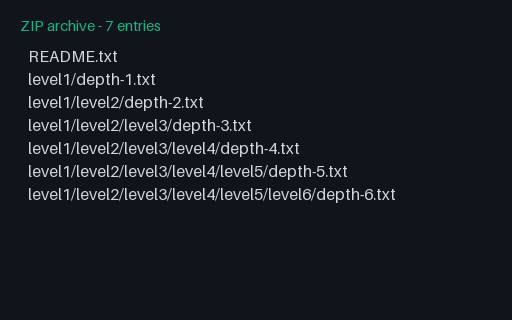
- zipZIP - Deep Directory TreeA ZIP archive: a file nested six directory levels deep. Deterministic (fixed member timestamps) and safe to extract anywhere.
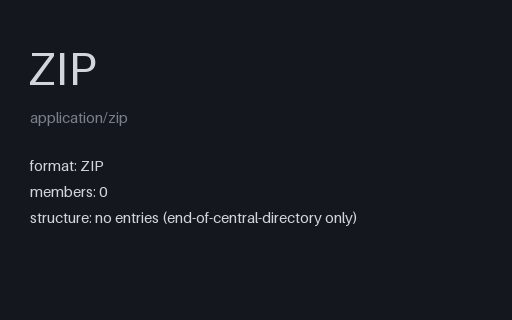
- zipZIP - Empty ArchiveA valid ZIP with zero entries: the empty-archive edge case for testing how unarchivers handle a container with nothing inside.
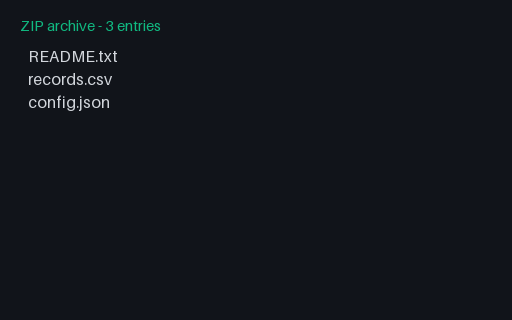
- zipZIP - FlatA ZIP archive: 3 files at the root, no directories. Deterministic (fixed member timestamps) and safe to extract anywhere.
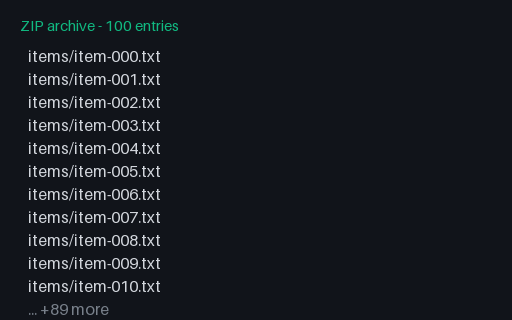
- zipZIP - Many Small FilesA ZIP archive: 100 tiny files for throughput testing. Deterministic (fixed member timestamps) and safe to extract anywhere.
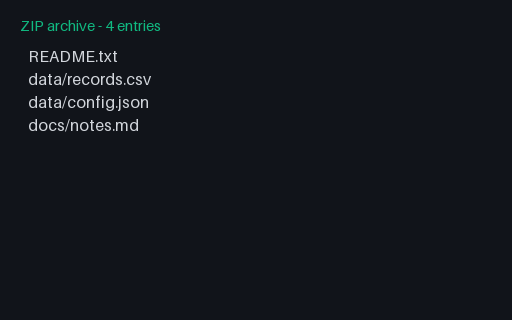
- zipZIP - Nested FoldersA ZIP archive: files organised into data/ and docs/ subfolders. Deterministic (fixed member timestamps) and safe to extract anywhere.
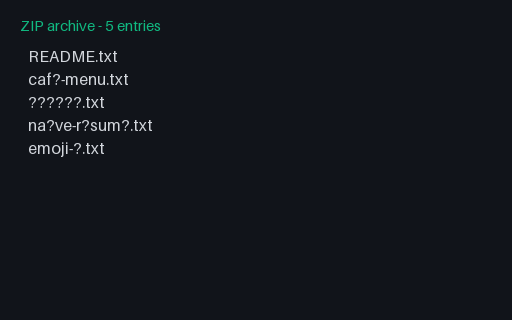
- zipZIP - Unicode FilenamesA ZIP archive, UTF-8 filenames: accents, Japanese, emoji. Deterministic (fixed member timestamps) and safe to extract anywhere.