Find files, editable templates and browser test targets by what you need to make or test. The directory below is cut by format; the two collections under it cut the same library by subject and by workflow.
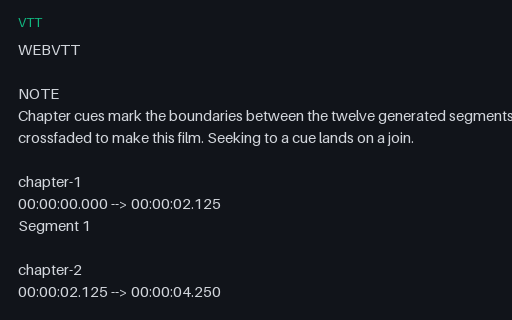
A WebVTT chapter track for the 24 second film in this group, with 12 cues at 2.125 second intervals. The cues are not decoration: each one marks a boundary between two of the twelve generated segments, verified against the measured transitions, so seeking to a cue lands on a join. Chapter tracks over two-second clips have nowhere to seek to; this is the first in this library with somewhere to go.
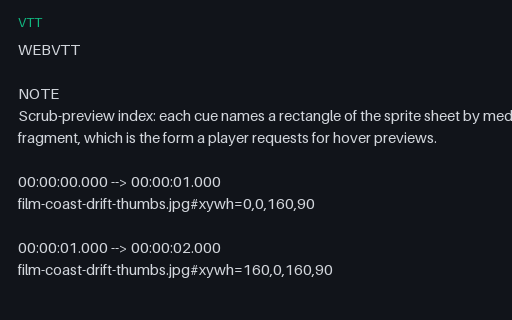
The WebVTT index for the sprite sheet in this group: 24 cues, one per second, each naming a rectangle of the sheet with an xywh media fragment. The sheet and this index are each useless alone, which is why they are paired.
The shared pan-city base plate encoded with AV1 (libaom-av1). Royalty-free and now decoded by every current browser. Encoding is far slower than H.264, which is why this fixture uses a fast preset; the bitstream is standard regardless. Every clip in this group carries the identical picture, so a decoder-support matrix built from them isolates the codec as the only variable.
The shared pan-city base plate encoded with FFV1 level 3 (lossless). Mathematically lossless: decoding reproduces the source pixels bit for bit. Used for archival preservation, and the right reference when you need to prove a processing step, not a codec, caused a change. Every clip in this group carries the identical picture, so a decoder-support matrix built from them isolates the codec as the only variable.
The shared pan-city base plate encoded with H.264 (libx264). The universal baseline. Decodes everywhere, hardware-accelerated on essentially every device shipped this decade. If a pipeline handles only one codec, this is it. Every clip in this group carries the identical picture, so a decoder-support matrix built from them isolates the codec as the only variable.
The shared pan-city base plate encoded with HEVC (libx265). Roughly half the bitrate of H.264 at the same quality, but patent licensing kept it out of browsers. Tagged hvc1 rather than hev1, which is what Safari and QuickTime require: the wrong tag is a common cause of a file that plays everywhere except on Apple hardware. Every clip in this group carries the identical picture, so a decoder-support matrix built from them isolates the codec as the only variable.
The shared pan-city base plate encoded with MJPEG. Every frame is an independent JPEG, with no inter-frame prediction at all. Large, but it makes any frame a clean cut point, which is why cameras and capture cards still emit it. Every clip in this group carries the identical picture, so a decoder-support matrix built from them isolates the codec as the only variable.
The shared pan-city base plate encoded with MPEG-2 (mpeg2video). The DVD and broadcast codec. Intra-heavy and inefficient by modern standards, but it is the format broadcast and archive workflows are still built around. Every clip in this group carries the identical picture, so a decoder-support matrix built from them isolates the codec as the only variable.
The shared pan-city base plate encoded with MPEG-4 Part 2 (DivX/Xvid-compatible). The DivX/Xvid era, tagged XVID in an AVI. Predates H.264 and is still what a great deal of archived material is stored as, so ingest pipelines meet it constantly. Every clip in this group carries the identical picture, so a decoder-support matrix built from them isolates the codec as the only variable.
The shared pan-city base plate encoded with MS-MPEG-4 v3 (msmpeg4v3). Microsoft's non-standard MPEG-4 Part 2 variant: the 'DivX 3' bitstream. Deliberately incompatible with the standard decoder, which makes it a sharp test of whether a pipeline identifies codecs from the bitstream or from the FourCC. Every clip in this group carries the identical picture, so a decoder-support matrix built from them isolates the codec as the only variable.
The shared pan-city base plate encoded with FFmpeg prores_ks, profile 0 (proxy). An intra-only 10-bit 4:2:2 mezzanine written by FFmpeg's prores_ks encoder: the interchange shape editorial workflows expect. Described as ProRes-COMPATIBLE deliberately: this is FFmpeg's independent implementation, not Apple's encoder. Every clip in this group carries the identical picture, so a decoder-support matrix built from them isolates the codec as the only variable.
The shared pan-city base plate encoded with FLV1 / Sorenson Spark. The Flash video codec. Entirely historical for delivery, but FLV files persist throughout media archives and legacy CMS exports. Every clip in this group carries the identical picture, so a decoder-support matrix built from them isolates the codec as the only variable.
The shared pan-city base plate encoded with Theora (libtheora). The original open web video codec, in an Ogg container. Largely historical, but still the fallback path in older HTML5 players and a good test of whether a pipeline's format detection is driven by content rather than by a hardcoded list. Every clip in this group carries the identical picture, so a decoder-support matrix built from them isolates the codec as the only variable.
The shared pan-city base plate encoded with VP8 (libvpx). The first WebM codec, now legacy but still what MediaRecorder emits by default in several browsers, so it turns up in user-generated uploads far more often than its age suggests. Every clip in this group carries the identical picture, so a decoder-support matrix built from them isolates the codec as the only variable.
The shared pan-city base plate encoded with VP9 (libvpx-vp9). Google's royalty-free predecessor to AV1, and still the workhorse of WebM delivery. Plays natively in every major browser. Every clip in this group carries the identical picture, so a decoder-support matrix built from them isolates the codec as the only variable.
The shared pan-city base plate encoded with WMV2. Windows Media in an ASF container. Long obsolete, but it is what a large amount of corporate and archival material was encoded as, and few non-FFmpeg tools read it. Every clip in this group carries the identical picture, so a decoder-support matrix built from them isolates the codec as the only variable.
Wide-gamut primaries with a conventional SDR transfer: wide colour without HDR. Frequently mishandled because tooling assumes BT.2020 always implies PQ or HLG. Every clip in this group carries the SAME picture and differs only in its colour signalling, so any difference in how a player renders them is entirely a metadata-handling difference.
The standard-definition matrix. Decoding BT.601 content as BT.709 (or the reverse) shifts every colour subtly: greens and reds most visibly. It is the single most common colour bug in transcode pipelines, and this pair reproduces it on demand. Every clip in this group carries the SAME picture and differs only in its colour signalling, so any difference in how a player renders them is entirely a metadata-handling difference.
The HD standard, and what a player assumes when a file says nothing. The reference member of this group: every other clip carries identical pixels and different signalling. Every clip in this group carries the SAME picture and differs only in its colour signalling, so any difference in how a player renders them is entirely a metadata-handling difference.
HDR10 signalling: BT.2020 primaries with the SMPTE ST 2084 perceptual quantiser, 10-bit. Be clear about what this fixture is: the picture is ordinary SDR content TAGGED as HDR, so it is a test of metadata handling and tone-mapping paths, not a reference for HDR image quality. A player that ignores the transfer function will render it washed out and far too dark, which is precisely the failure worth reproducing. Every clip in this group carries the SAME picture and differs only in its colour signalling, so any difference in how a player renders them is entirely a metadata-handling difference.
Hybrid Log-Gamma, the broadcast HDR transfer designed to stay watchable on an SDR display. As with the HDR10 fixture, the picture itself is SDR content carrying HLG signalling, so this tests transfer-function detection and the SDR fallback path rather than HDR rendering. Every clip in this group carries the SAME picture and differs only in its colour signalling, so any difference in how a player renders them is entirely a metadata-handling difference.
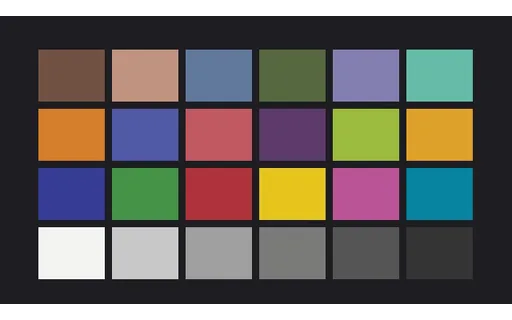
The full-colour reference for the colour-patches colourisation set. Every desaturated clip in this group was derived from these exact pixels with a documented luma transform, so a colouriser's output can be scored against the true colours, and on this plate the 24 patch values are fixed and published, so the comparison can be made per patch rather than as a whole-frame average.
The full-colour reference for the gradient-sky colourisation set. Every desaturated clip in this group was derived from these exact pixels with a documented luma transform, so a colouriser's output can be scored against the true colours.
The full-colour reference for the pan-city colourisation set. Every desaturated clip in this group was derived from these exact pixels with a documented luma transform, so a colouriser's output can be scored against the true colours.