Find files, editable templates and browser test targets by what you need to make or test. The directory below is cut by format; the two collections under it cut the same library by subject and by workflow.
Eight container-level metadata fields written into the same eight-second clip, so a metadata reader can be checked against a file whose expected values are published rather than guessed. Every value is obviously sample data.
Matroska stores tags as arbitrary name/value SimpleTags scoped to a target level, so it has no fixed vocabulary and nothing is dropped. The same eight fields as the MP4 in this group: compare the two to see exactly which values survive a cross-container remux and which are quietly lost.
Eight container-level metadata fields written into the same eight-second clip, so a metadata reader can be checked against a file whose expected values are published rather than guessed. Every value is obviously sample data.
MP4 stores these in an iTunes-style `moov/udta/meta/ilst` atom, with fixed four-character keys. Fields outside that vocabulary (`description` here) are written as freeform `----` atoms that many readers skip, so a tag can be present in the file and invisible to the tool you are testing.
A start timecode of 01:00:00:00: the broadcast convention of beginning programme material at hour one, so that bars, slates and pre-roll can live before it without going negative. FFmpeg writes it as a QuickTime `tmcd` track.
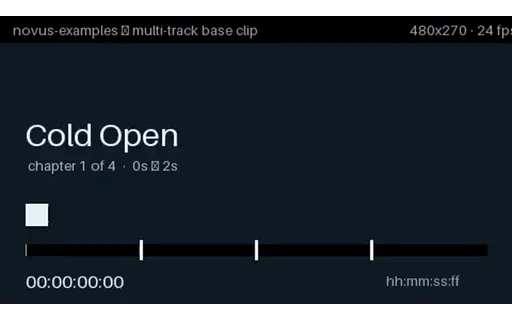
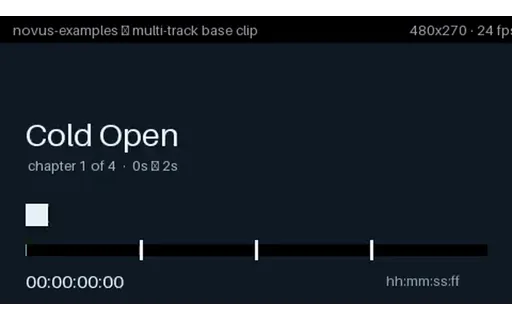
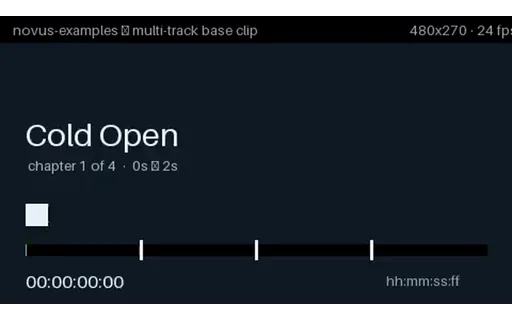
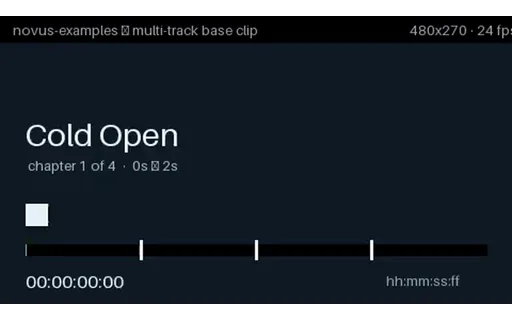
The burned-in timecode in the picture deliberately starts at 00:00:00:00 instead. That one-hour disagreement is the whole point: an editor or QC tool that reads the timecode track shows 01:00:00:00 at the first frame, one that reads elapsed time shows zero, and a file where they agree cannot tell you which your tool is doing. Non-drop-frame, since 24 fps has no drop-frame variant.
The same clip with every scrap of metadata removed: no tags, no creation time, not even the encoder string FFmpeg normally writes. The control for this group and the baseline for a privacy or scrubbing tool: if your stripper leaves anything this file does not have, it is not stripping enough.
Getting to genuinely zero takes `-map_metadata -1` **and** `-fflags +bitexact` placed after the input, as an output option. `-map_metadata -1` alone still leaves the `encoder=Lavf…` tag behind, and putting the bitexact flag before `-i` applies it to the demuxer where it does nothing to the output, which is the usual reason a file someone believes they stripped still names the software that made it.
What cannot be removed: `major_brand`, `minor_version` and `compatible_brands`. Probing tools list those alongside the tags, but they are fields of the `ftyp` box that define what the file is, not metadata about it.
A CMAF initialisation segment: the moov box carrying codec configuration and track metadata, with no media samples. A player must fetch this before any media segment of the same rendition, and switching renditions mid-stream means fetching the new rendition's init first: the step ABR implementations most often get wrong.
A CMAF initialisation segment: the moov box carrying codec configuration and track metadata, with no media samples. A player must fetch this before any media segment of the same rendition, and switching renditions mid-stream means fetching the new rendition's init first: the step ABR implementations most often get wrong.
A CMAF initialisation segment: the moov box carrying codec configuration and track metadata, with no media samples. A player must fetch this before any media segment of the same rendition, and switching renditions mid-stream means fetching the new rendition's init first: the step ABR implementations most often get wrong.
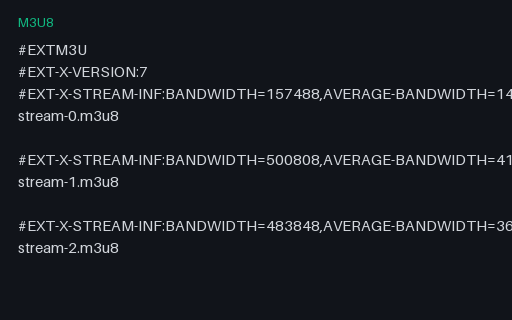
The entry point to a COMPLETE and genuinely playable HLS package: a 3-rung ladder (320x180 at 300 kbps, 480x270 at 700 kbps, 640x360 at 1400 kbps) with real CMAF segments alongside it in this group. Point hls.js or Safari at this URL and it plays: it is served inline with permissive CORS from /files/stream/, so it works cross-origin without re-hosting. Unlike the hand-authored HLS fixtures elsewhere in the catalog, which are parser tests that reference placeholder segment names on purpose, everything this playlist references actually exists.
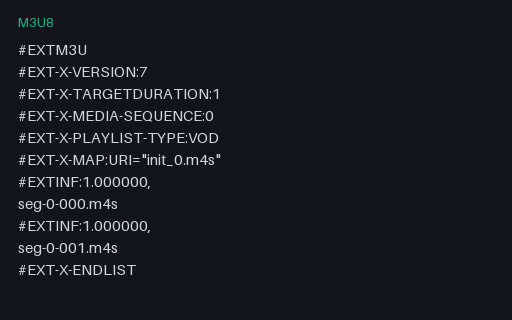
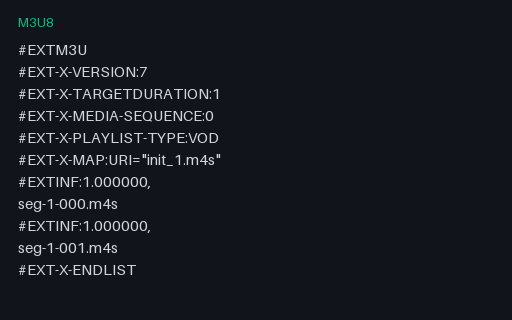
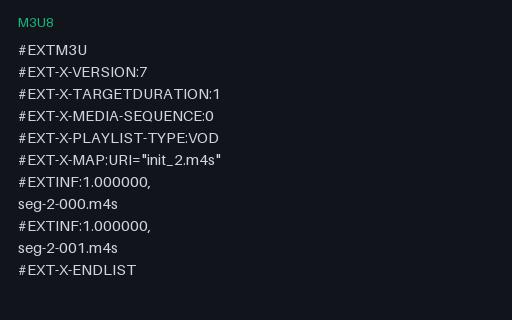
One rendition of the playable HLS ladder, listing its own CMAF init segment and media segments. Referenced by the master playlist in this group. Generated by ffmpeg's own HLS muxer, so the segment durations, the EXT-X-MAP and the ENDLIST are exactly what a real packager emits rather than what a human thinks one emits.
One rendition of the playable HLS ladder, listing its own CMAF init segment and media segments. Referenced by the master playlist in this group. Generated by ffmpeg's own HLS muxer, so the segment durations, the EXT-X-MAP and the ENDLIST are exactly what a real packager emits rather than what a human thinks one emits.
One rendition of the playable HLS ladder, listing its own CMAF init segment and media segments. Referenced by the master playlist in this group. Generated by ffmpeg's own HLS muxer, so the segment durations, the EXT-X-MAP and the ENDLIST are exactly what a real packager emits rather than what a human thinks one emits.
A one-second fragmented-MP4 media segment (moof + mdat) from the playable ladder. It starts on a keyframe, so it decodes independently once the matching init segment has been loaded, which is what makes mid-stream quality switching possible at all.
A one-second fragmented-MP4 media segment (moof + mdat) from the playable ladder. It starts on a keyframe, so it decodes independently once the matching init segment has been loaded, which is what makes mid-stream quality switching possible at all.
A one-second fragmented-MP4 media segment (moof + mdat) from the playable ladder. It starts on a keyframe, so it decodes independently once the matching init segment has been loaded, which is what makes mid-stream quality switching possible at all.
A one-second fragmented-MP4 media segment (moof + mdat) from the playable ladder. It starts on a keyframe, so it decodes independently once the matching init segment has been loaded, which is what makes mid-stream quality switching possible at all.
A one-second fragmented-MP4 media segment (moof + mdat) from the playable ladder. It starts on a keyframe, so it decodes independently once the matching init segment has been loaded, which is what makes mid-stream quality switching possible at all.
A one-second fragmented-MP4 media segment (moof + mdat) from the playable ladder. It starts on a keyframe, so it decodes independently once the matching init segment has been loaded, which is what makes mid-stream quality switching possible at all.
An intentionally corrupt HLS playlist with the mandatory #EXTM3U signature removed. Everything else is valid. The specification requires the first line to be exactly #EXTM3U and that clients reject anything else, so this separates conforming parsers from lenient ones that sniff for EXT tags instead.
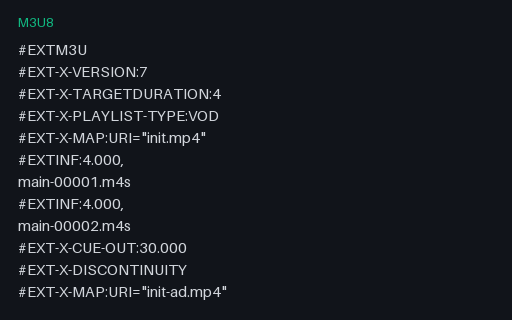
A media playlist with a mid-roll spliced in: EXT-X-CUE-OUT opens the break, EXT-X-DISCONTINUITY marks each boundary, and a fresh EXT-X-MAP re-initialises the decoder on both sides. This is what a packager produces from the SCTE-35 splice_insert fixture in this wave. Discontinuities are where players most often stall, because the timeline and the decoder both have to be reset.
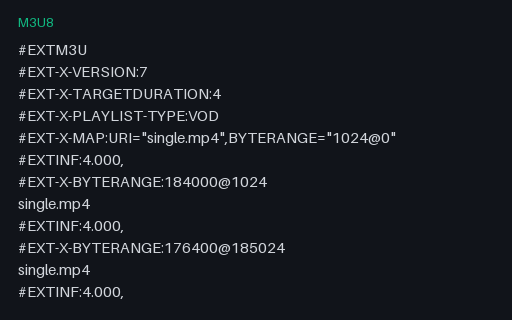
Every segment is a byte range of one backing file rather than a separate download, which is how low-overhead VOD packaging avoids thousands of small objects. The /files/stream/ headers expose Content-Range and Accept-Ranges cross-origin precisely so a player can do this from another origin. Tests Range request construction and offset arithmetic.
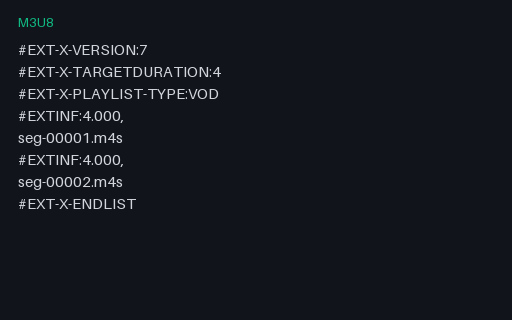
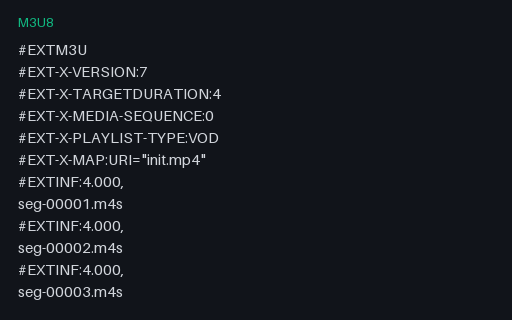
A VOD media playlist in CMAF form: an EXT-X-MAP initialisation segment followed by four fragmented-MP4 segments and an explicit ENDLIST. The final segment is deliberately short, as a real encode's last segment usually is. Tests target-duration handling, init-segment fetching, and correct total-duration arithmetic. A manifest-parsing fixture: the segments themselves ship with the streaming phase.
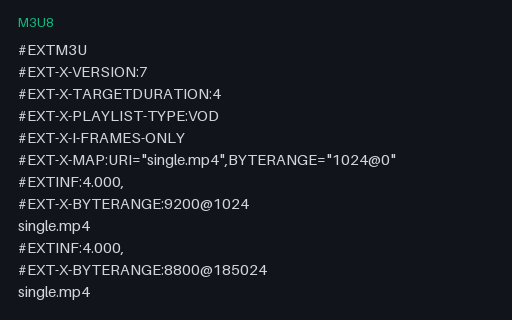
An I-frame-only playlist: each entry is a byte range covering a single keyframe inside the media file, which is how players render scrub previews and fast-forward without decoding every frame. Declared in a master playlist via EXT-X-I-FRAME-STREAM-INF. Tests that a parser distinguishes these from normal media playlists, playing one as ordinary media produces a stuttering slideshow.
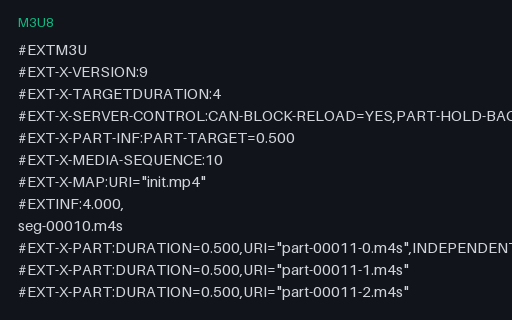
A Low-Latency HLS playlist: half-second EXT-X-PART fragments published ahead of their parent segment, a preload hint for the part still being written, and EXT-X-SERVER-CONTROL advertising blocking playlist reload. There is deliberately no ENDLIST, because this is a live playlist. Tests parsers against the LL-HLS tags, which are frequently unimplemented and must at minimum be ignored safely.