Find files, editable templates and browser test targets by what you need to make or test. The directory below is cut by format; the two collections under it cut the same library by subject and by workflow.
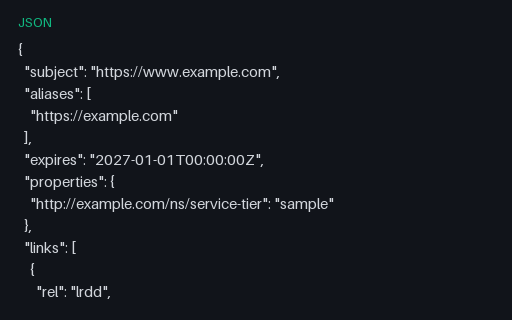
The JSON Resource Descriptor twin of the XRD host-meta: identical subject, alias, expiry, property and three links, expressed with lower-case JSON member names. For testing XRD-to-JRD conversion against a known answer.
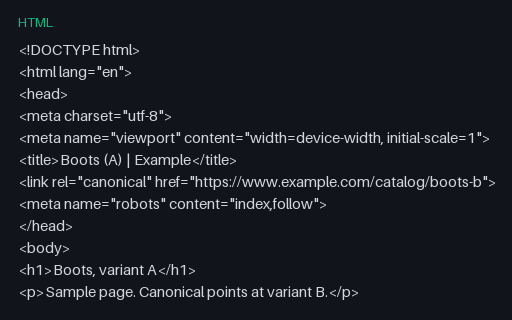
Page A of a deliberately invalid two-page canonical loop: A declares B canonical while B declares A canonical, so no page in the pair is its own canonical. For testing that a crawler detects the cycle instead of following it forever.
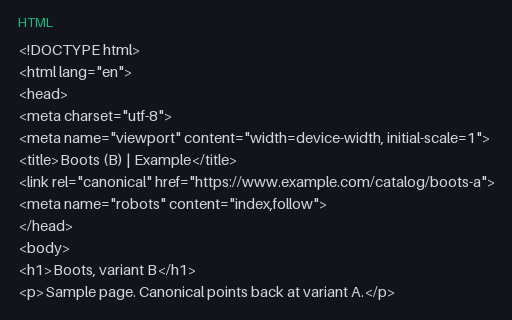
Page B of the deliberately invalid canonical loop, closing the cycle by naming page A as its canonical. Ships with page A so the loop can actually be traversed rather than described.
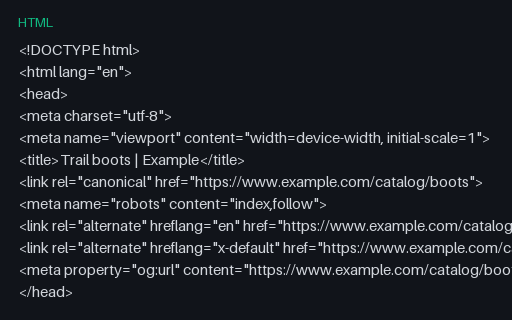
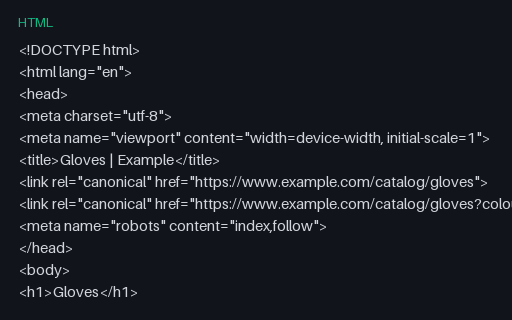
The baseline every canonical audit should pass: one self-referential canonical, an indexable robots meta, matching hreflang self-reference and an og:url that agrees with all of them. For use as the comparison reference against the conflicting pages in this set.
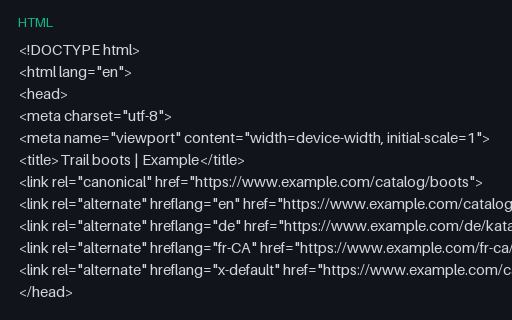
The English member of a correct three-locale hreflang cluster: it lists itself, both translations and the x-default, and its canonical agrees. Ships with the German page so reciprocity can be verified across real files.
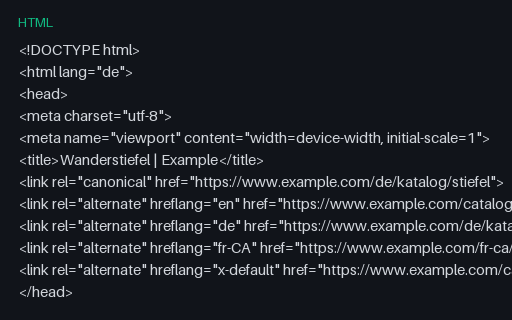
The German member of the same cluster, with lang="de" on the html element and the identical alternate block. For testing that an audit compares the annotation set rather than the document language, and that the two agree.
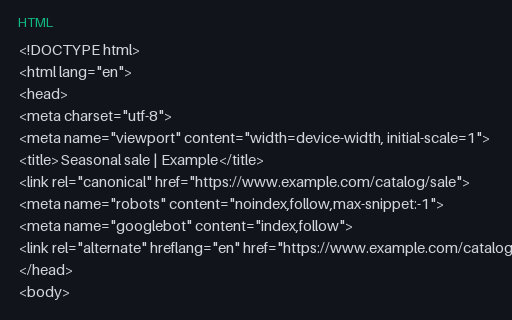
A page that names itself canonical while telling robots not to index it, and then contradicts that again with an agent-specific googlebot meta that permits indexing. For testing directive precedence when a page argues with itself.
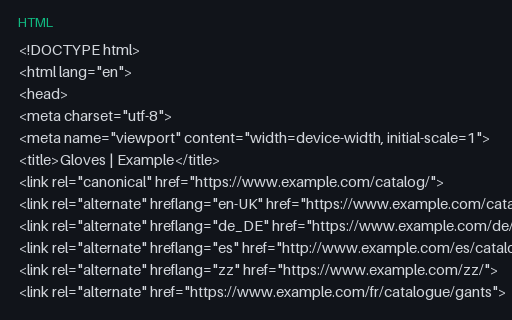
A deliberately invalid annotation block: `en-UK` is not a region code, `de_DE` uses an underscore, `zz` is not a language, one alternate has no hreflang attribute at all, one drops to http, there is no x-default, and the canonical points outside the cluster. For testing that every defect is reported, not just the first.
A deliberately invalid page carrying two canonical tags in the head and a third in the body. Search engines ignore body-level canonicals entirely and treat multiple head-level ones as a conflict. For testing that an extractor reports position as well as value.
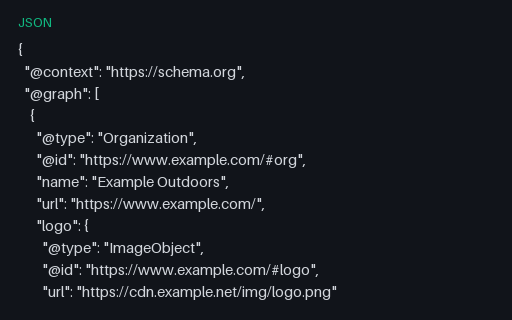
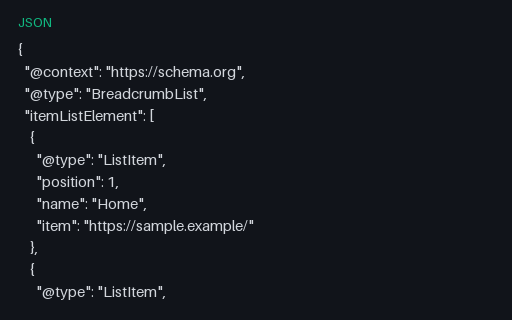
A single @graph holding four nodes wired together by @id rather than by nesting - the shape most CMS plugins emit - including a SearchAction, a breadcrumb whose last item has no URL, and one reference to a product node that lives on another page. For testing graph flattening and reference resolution.
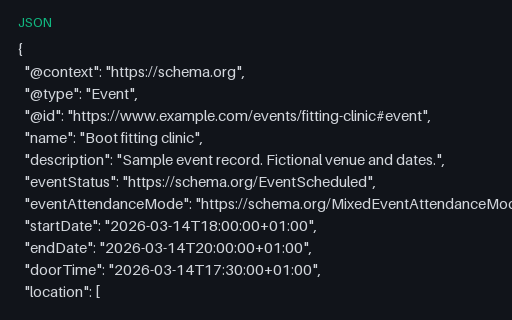
A valid Event record for a hybrid event: both a physical Place with a postal address and geo coordinates and a VirtualLocation, plus a free Offer and a capacity. For testing array-valued properties and event date/timezone handling.
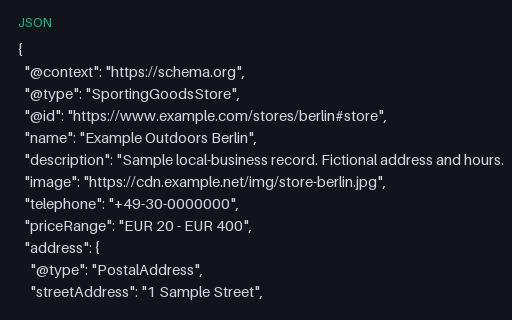
A valid LocalBusiness (as a SportingGoodsStore subtype) with a postal address, geo coordinates, weekday and Saturday opening hours, and a 00:00-00:00 specification marking a holiday closure. For testing opening-hours parsing and the closed-all-day convention.
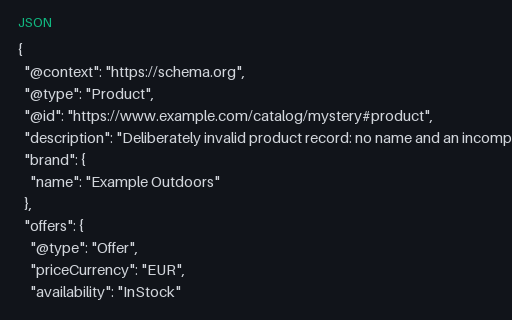
A deliberately invalid Product record: no name, an Offer with a currency but no price, a brand with no @type, a Review with no rating, an AggregateRating with no ratingValue, and an availability given as a bare token instead of a schema.org URL. Valid JSON throughout, so the failure is semantic.
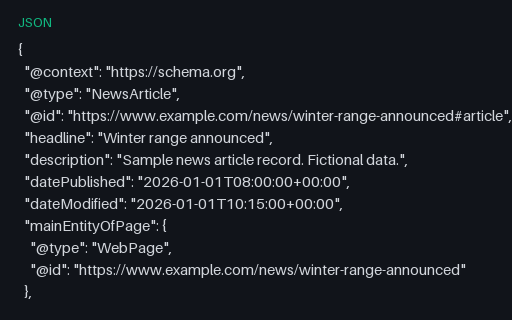
A valid NewsArticle with two authors, a publisher whose logo carries explicit pixel dimensions, three images at the aspect ratios news results expect, and both publication and modification timestamps. For testing article extraction and date normalisation.
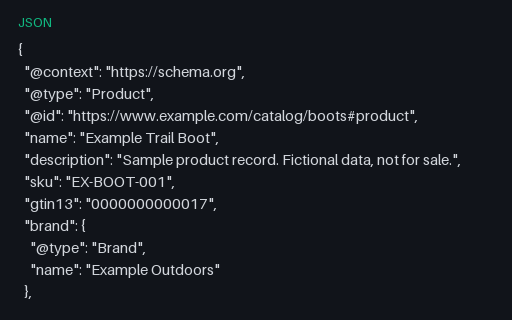
A valid Product record with a nested Offer carrying price, currency, availability, condition and shipping details, plus an AggregateRating. For testing rich-result validators and structured-data extractors against a document that should pass cleanly.
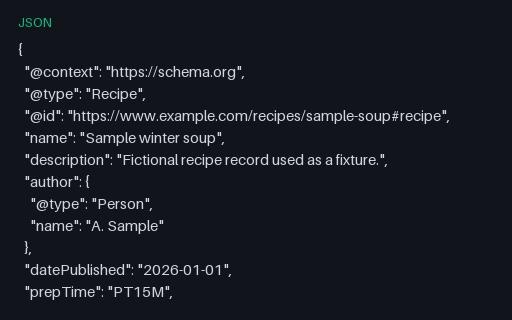
A valid Recipe with ISO 8601 durations, four ingredients, and instructions that mix flat HowToStep nodes with a nested HowToSection. For testing duration parsing and recursive instruction extraction.
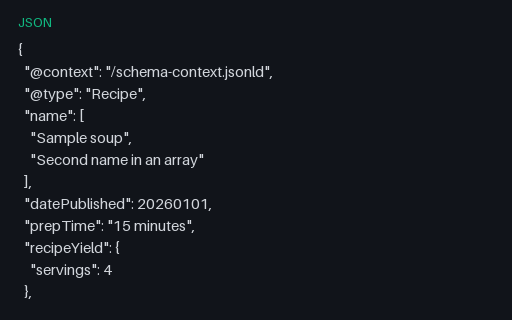
A deliberately invalid Recipe carrying six unambiguously wrong-typed values - a numeric datePublished, a prose prepTime where an ISO 8601 duration belongs, an object recipeYield, two non-numeric ratings and a misspelled @type - plus a relative @context that never resolves, an untyped image object and two ingredients crammed into one string. For testing the limits of type coercion.