API Response: Users Page 1 (JSON)
Page 1 of a paginated JSON API response (users), with page metadata and a `hasMore` flag. Paired with page 2 for testing pagination and infinite-scroll logic.
{
  "page": 1,
  "pageSize": 3,
  "total": 5,
  "hasMore": true,
  "items": [
    {
      "id": 1,
      "name": "Ada Lovelace",
      "email": "ada.lovelace@example.com",
      "role": "admin"
    },
    {
      "id": 2,
      "name": "Alan Turing",
      "email": "alan.turing@example.com",
      "role": "member"
    },
    {
      "id": 3,
      "name": "Grace Hopper",
      "email": "grace.hopper@example.com",
      "role": "guest"
    }
  ]
}
Specifications
- Format
- JSON
- Kind
- paginated response
- Page
- 1
- Items
- 3
- Total
- 5
Testing contract
Expected to pass- Scenario
- Exercise API Response: Users Page 1 (JSON) in its api workflow. Page 1 of a paginated JSON API response (users), with page metadata and a `hasMore` flag.
- Expected result
- top-level keys are page, pageSize, total, hasMore, items; array lengths: items=3; selected values: {"page": 1, "pageSize": 3, "total": 5, "hasMore": true}. Declared feature checks: kind=paginated response; page=1; items=3; total=5.
What is a .json file?
JSON (JavaScript Object Notation) is a lightweight, text-based data-interchange format representing objects, arrays, strings, numbers, booleans, and null. It is language-independent, human-readable, and the dominant format for web APIs and configuration. It requires a single well-formed root value.
How to use this file
Use an example JSON file to test parsers and serializers, schema validation, Unicode and number-precision handling, and API request or response processing.
How to use this file for testing
“API Response: Users Page 1 (JSON)” is a deterministic Testaroo fixture for API testing, Conversion testing. OpenAPI/Swagger specs, GraphQL SDL, JSON Schema, paginated and problem+json error payloads, and webhook samples, for testing API clients, mock servers, contract tests, and schema validators.
Documented properties for this file: JSON. Compare results against paired or grouped companions on this page when present (clean↔damaged, searchable↔scanned, or format twins) so scores stay reproducible across runs.
Download the file once, keep the path stable in CI or local scripts, and treat the spec table as the contract: dimensions, seeds, field lists, and roles are intentional. Corrupt or invalid samples are labelled as such, expect parsers to fail loudly rather than silently accept them.
Data fixtures document their exact quirks (delimiters, encodings, null handling, schema, and row counts) in the spec table. Point your parser or importer at the file and assert it handles the documented edge cases; clean and deliberately-messy siblings make before/after diffs straightforward.
Code examples
import json

with open("users-page-1.json") as f:
    data = json.load(f)
print(type(data), len(data))
Generated by generation/data_dev_fixtures.py. Free for any use, no attribution required, license.
Related files
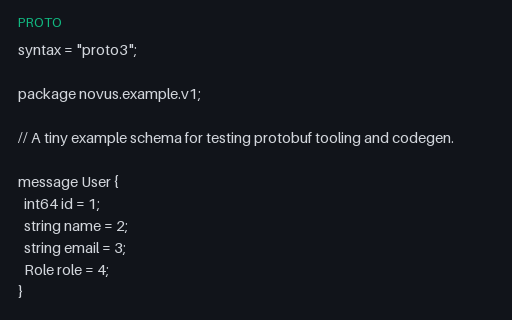
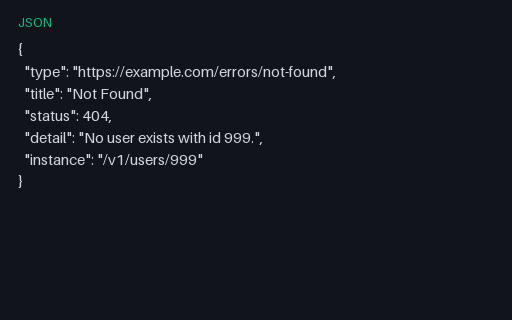
- jsonAPI Error: 404 (RFC 9457 problem+json)A 404 error body in RFC 9457 (problem+json) form, with type, title, status, detail, and instance, for testing structured error handling and problem-detail parsers.
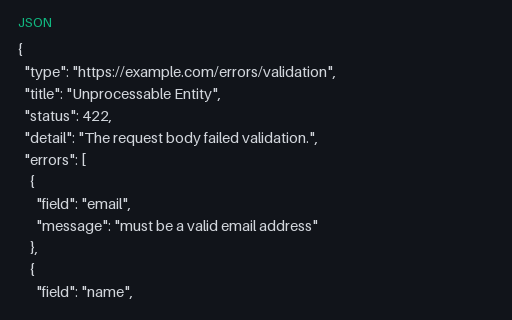
- jsonAPI Error: 422 Validation (JSON)A 422 validation-error response with a machine-readable list of field errors, for testing form-validation surfacing and error mapping.
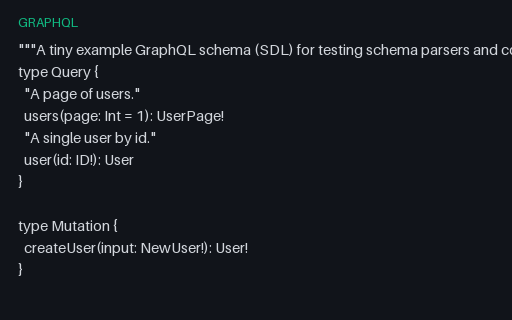
- graphqlGraphQL Schema (SDL)A GraphQL Schema Definition Language (SDL) file with queries, a mutation, object/input types, and an enum, for testing GraphQL schema parsers, linters, and code generators.
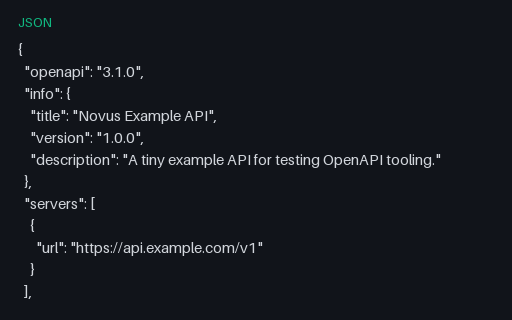
- jsonOpenAPI 3.1 Spec (JSON)A small but complete OpenAPI 3.1 description (two paths, three schemas) in JSON, for testing API tooling, mock servers, client codegen, and docs generators.
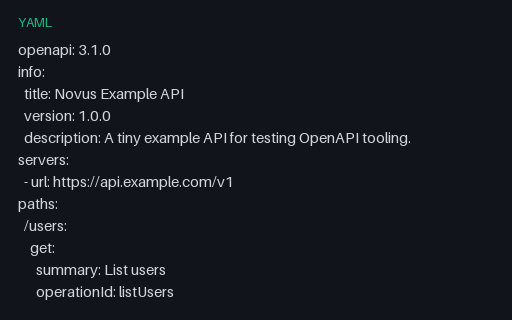
- yamlOpenAPI 3.1 Spec (YAML)The same OpenAPI 3.1 description in YAML: the format most API definitions ship in. Paired with the JSON twin for testing YAML↔JSON conversion and spec parsers.
- protoProtocol Buffers Schema (proto3)A proto3 Protocol Buffers schema with messages, an enum, and a repeated field, for testing protobuf compilers (protoc), codegen, and schema tooling.