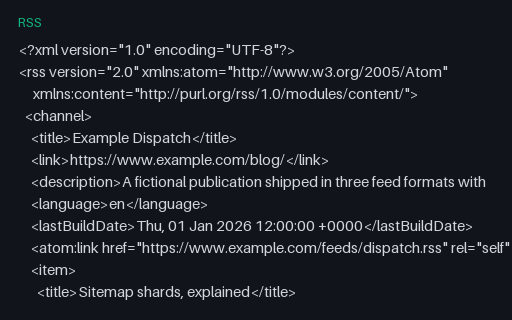
RSS 2.0 Feed
A well-formed RSS 2.0 feed with a channel and multiple items, for testing feed readers and parsers.
<?xml version="1.0" encoding="UTF-8"?>
<rss version="2.0">
  <channel>
    <title>Novus Examples Feed</title>
    <link>https://examples.novusstreamsolutions.com</link>
    <description>Sample RSS feed for parser testing</description>
    <item>
      <title>First post</title>
      <link>https://example.com/1</link>
      <guid>1</guid>
      <pubDate>Wed, 01 Jan 2026 09:00:00 GMT</pubDate>
      <description>The first item.</description>
    </item>
    <item>
      <title>Second post</title>
      <link>https://example.com/2</link>
      <guid>2</guid>
      <pubDate>Thu, 02 Jan 2026 09:00:00 GMT</pubDate>
      <description>The second item.</description>
    </item>
  </channel>
</rss>
Specifications
- Format
- RSS 2.0
- Items
- 2
- Channel
- Novus Examples Feed
- Encoding
- UTF-8
Testing contract
Expected to pass- Scenario
- Exercise RSS 2.0 Feed in its feeds workflow. A well-formed RSS 2.0 feed with a channel and multiple items, for testing feed readers and parsers.
- Expected result
- 22 text lines, decoded as UTF-8; first nonempty line is '<?xml version="1.0" encoding="UTF-8"?>'. Declared feature checks: items=2; channel=Novus Examples Feed.
What is a .rss file?
RSS (Really Simple Syndication) is an XML-based web feed format that publishes a channel of items with titles, links, descriptions, and publication dates. It lets readers and aggregators track updates to blogs, news, and podcasts. It is a long-established syndication standard.
How to use this file
Use an example RSS file to test feed parsers, item and metadata extraction, and aggregator or podcast-client ingestion logic.
How to use this file for testing
“RSS 2.0 Feed” is a deterministic Testaroo fixture for Feed parsing. Well-formed RSS 2.0 and Atom feeds with multiple entries, for testing feed readers and parsers.
Documented properties for this file: UTF-8 · RSS 2.0. Compare results against paired or grouped companions on this page when present (clean↔damaged, searchable↔scanned, or format twins) so scores stay reproducible across runs.
Download the file once, keep the path stable in CI or local scripts, and treat the spec table as the contract: dimensions, seeds, field lists, and roles are intentional. Corrupt or invalid samples are labelled as such, expect parsers to fail loudly rather than silently accept them.
Data fixtures document their exact quirks (delimiters, encodings, null handling, schema, and row counts) in the spec table. Point your parser or importer at the file and assert it handles the documented edge cases; clean and deliberately-messy siblings make before/after diffs straightforward.
Code examples
import feedparser  # pip install feedparser

feed = feedparser.parse("feed.rss")
print(feed.feed.get("title"))
for e in feed.entries[:5]:
    print(e.title, e.link)
Generated by generation/data_formats.py. Free for any use, no attribution required, license.
Related files
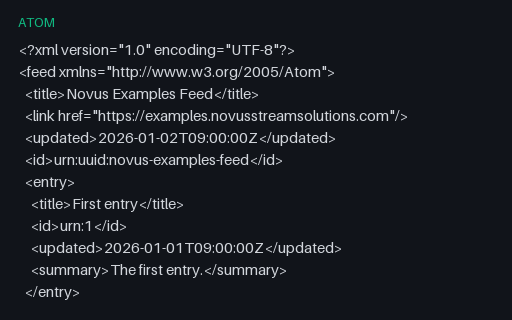
- atomAtom FeedA well-formed Atom feed with multiple entries, for testing feed readers and parsers.
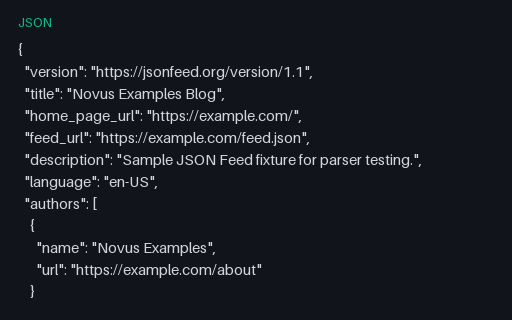
- jsonJSON Feed 1.1A JSON Feed 1.1 document (the JSON alternative to RSS/Atom) with a feed header and three items using content_html, content_text, tags, and publish dates, for testing JSON Feed parsers and readers.
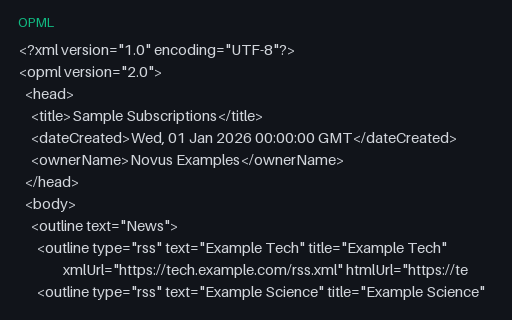
- opmlOPML Subscription ListAn OPML 2.0 subscription list with nested outline groups and three feed entries (title, xmlUrl, htmlUrl): the format RSS readers use to import and export subscriptions, for testing OPML parsers.
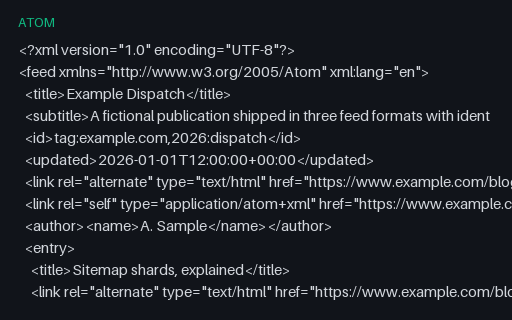
- atomFeed twin - Atom 1.0The same four articles as Atom 1.0: tag: ids identical to the RSS twin, RFC 3339 published and updated timestamps, escaped HTML content, and both alternate and self links. For diffing an RSS-to-Atom converter against a known answer.
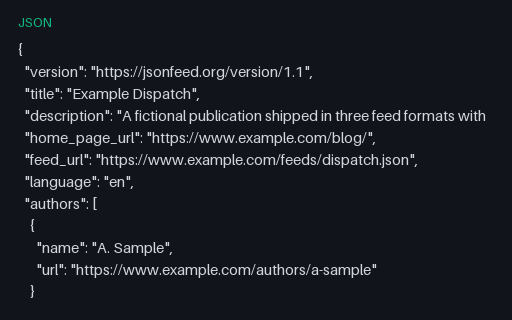
- jsonFeed twin - JSON Feed 1.1The third twin: the same four articles as JSON Feed 1.1, using the 1.1 `authors` array rather than the 1.0 singular form, with ids, URLs, summaries, HTML bodies and timestamps identical to the RSS and Atom files. The reference output for an XML-to-JSON feed converter.
- rssFeed twin - RSS 2.0Four articles of a fictional publication as RSS 2.0, with a self-referential atom:link, non-permalink tag: GUIDs, RFC 822 dates and full HTML bodies in content:encoded. One of three twins carrying identical content, so a feed converter can be diffed against a known answer.