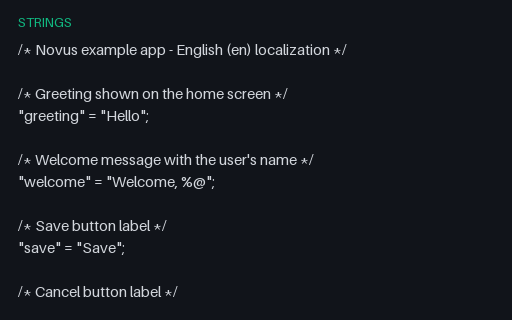
i18next JSON: Arabic (RTL)
A right-to-left Arabic i18next catalog: real Arabic UI strings for testing bidirectional text handling, RTL layout, Unicode, and font fallback.
{
  "greeting": "مرحبا",
  "welcome": "أهلاً بك، {{name}}",
  "save": "حفظ",
  "cancel": "إلغاء",
  "search": "بحث",
  "settings": "الإعدادات",
  "logout": "تسجيل الخروج"
}
Specifications
- Format
- i18next JSON
- Language
- ar
- Direction
- rtl (right-to-left)
- Script
- Arabic
Testing contract
Expected to pass- Scenario
- Exercise i18next JSON: Arabic (RTL) in its rtl workflow. A right-to-left Arabic i18next catalog: real Arabic UI strings for testing bidirectional text handling, RTL layout, Unicode, and font fallback.
- Expected result
- top-level keys are greeting, welcome, save, cancel, search, settings, logout. Declared feature checks: language=ar; direction=rtl (right-to-left); script=Arabic.
What is a .json file?
JSON (JavaScript Object Notation) is a lightweight, text-based data-interchange format representing objects, arrays, strings, numbers, booleans, and null. It is language-independent, human-readable, and the dominant format for web APIs and configuration. It requires a single well-formed root value.
How to use this file
Use an example JSON file to test parsers and serializers, schema validation, Unicode and number-precision handling, and API request or response processing.
How to use this file for testing
“i18next JSON: Arabic (RTL)” is a deterministic Testaroo fixture for Localization catalogs, Internationalization, Editor testing. Gettext PO/POT, XLIFF, Apple .strings, Flutter .arb, Android strings.xml, .NET .resx, and i18next JSON (with RTL and CJK variants) for testing localization pipelines, translation-memory tools, and catalog converters.
Documented properties for this file: ar · i18next JSON. Compare results against paired or grouped companions on this page when present (clean↔damaged, searchable↔scanned, or format twins) so scores stay reproducible across runs.
Download the file once, keep the path stable in CI or local scripts, and treat the spec table as the contract: dimensions, seeds, field lists, and roles are intentional. Corrupt or invalid samples are labelled as such, expect parsers to fail loudly rather than silently accept them.
Translation-catalog fixtures carry the same message set across formats, each with its native placeholder syntax. Test your i18n loader, catalog converter, or translation-memory tool, and use the RTL and CJK variants to check bidirectional text and Unicode handling.
Load the catalog with your i18n framework and verify placeholder interpolation and plural handling; the RTL and CJK variants exercise bidirectional text and font fallback.
Code examples
import json

with open("ar.json") as f:
    data = json.load(f)
print(type(data), len(data))
Generated by generation/localization.py. Free for any use, no attribution required, license.
Related files
- jsoni18next JSON: Hebrew (RTL)A right-to-left Hebrew i18next catalog: real Hebrew UI strings for testing bidirectional text handling, RTL layout, Unicode, and font fallback.
- resx.NET RESX: EnglishA .NET Resources.resx file (English) with the standard ResX schema and resheader block plus name/value string data and comments, using {0} composite-format placeholders.
- resx.NET RESX: SpanishThe Spanish satellite RESX (Resources.es.resx), for testing .NET resource parsers and culture-based resource resolution against the same keys.
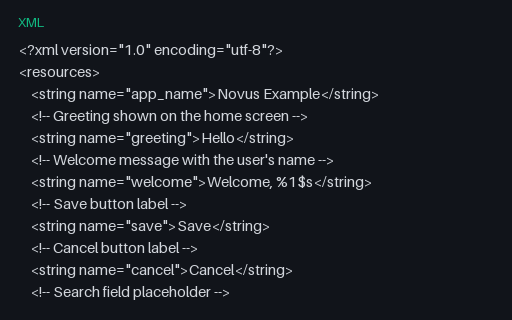
- xmlAndroid strings.xml: EnglishAn Android values/strings.xml (English) with string resources, a <plurals> block, and a <string-array>, using positional %1$s placeholders: the res/values/ default catalog.
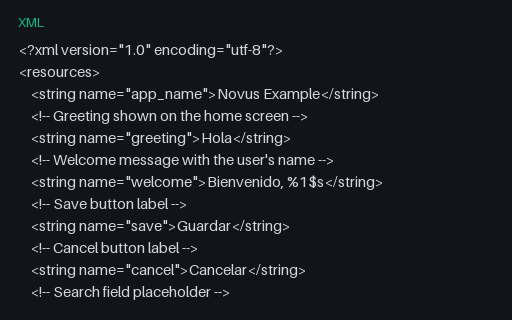
- xmlAndroid strings.xml: SpanishThe Spanish Android strings.xml (as res/values-es/), for testing Android resource parsers, plurals, and string-array localization.
- stringsApple .strings: EnglishAn Apple Localizable.strings file (English), quoted key = value pairs with comments and %@ placeholders, as iOS/macOS apps use per-locale in .lproj folders.