YAML with a UTF-8 Byte Order Mark
A YAML file beginning with a UTF-8 byte order mark, which the spec permits at the start of a stream. A parser that does not strip it reads the first key as \ufeffname, so the lookup misses and the document appears to be missing its name field.
# This file begins with a UTF-8 byte order mark (EF BB BF). The YAML spec allows a BOM at the
# start of a stream, but a parser that does not strip it sees the first key as "name"
# instead of "name" — so the lookup misses and the document looks empty of that field.
name: bom-prefixed-pipeline
stages:
  - build
  - test

settings:
  strict: true
  timeout: 30
Specifications
- Encoding
- UTF-8 with BOM
- Bom Bytes
- EF BB BF
- Line Endings
- LF
- Keys
- 3
- Edge Case
- an unstripped BOM makes the first key \ufeffname
Testing contract
Expected to pass- Scenario
- Load a BOM-prefixed YAML file and look up its first key
- Expected result
- The key "name" resolves to bom-prefixed-pipeline; a loader that leaves the BOM attached returns no such key
What is a .yaml file?
YAML (YAML Ain't Markup Language) is a human-readable data-serialization format using indentation, key-value pairs, and lists, and is a superset of JSON. It supports comments, anchors, and multiple documents per file, favoring readability for configuration. Its indentation sensitivity makes it error-prone to hand-edit.
How to use this file
Use an example YAML file to test config parsers, indentation and anchor handling, multi-document streams, and safe-loading to avoid arbitrary object construction.
How to use this file for testing
“YAML with a UTF-8 Byte Order Mark” is a deterministic Testaroo fixture for Config parsing, Encoding detection, Editor testing. TOML and INI configuration files with nested sections and typed values, for testing config parsers and loaders.
Documented properties for this file: UTF-8 with BOM · LF. Compare results against paired or grouped companions on this page when present (clean↔damaged, searchable↔scanned, or format twins) so scores stay reproducible across runs.
Download the file once, keep the path stable in CI or local scripts, and treat the spec table as the contract: dimensions, seeds, field lists, and roles are intentional. Corrupt or invalid samples are labelled as such, expect parsers to fail loudly rather than silently accept them.
Pipeline and infrastructure fixtures are inert configuration: steps reference fictional images and scripts, and nothing here executes. Run your linter, schema validator, migrator, or policy engine against them, and expect the deprecated-syntax and intentionally invalid variants to be rejected.
Point your config loader at the file and assert it reads the documented sections and typed values, including any deliberately-tricky nesting or comments.
Code examples
import yaml  # pip install pyyaml

with open("utf8-bom.yaml") as f:
    data = yaml.safe_load(f)
print(data)
Generated by generation/pipelines.py. Free for any use, no attribution required, license.
Related files
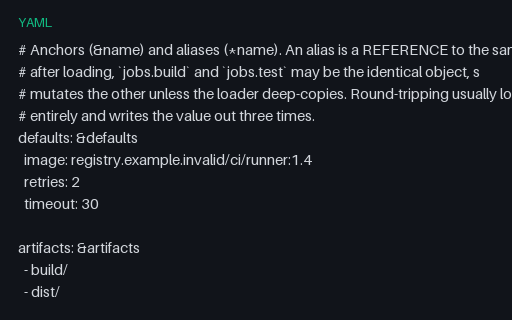
- yamlYAML Anchors and AliasesAnchors and aliases across mapping, sequence and scalar nodes, including an anchor nested inside another anchored node. The point most tooling misses: an alias is a reference to the same node, so a shallow-loading parser can share mutable state between jobs.
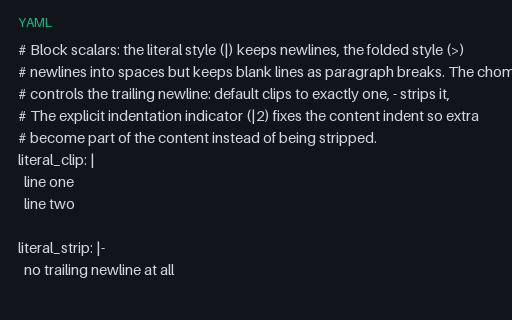
- yamlYAML Block Scalars and Chomping IndicatorsEvery block-scalar variation in one file: literal and folded styles, all three chomping indicators, an explicit indentation indicator, a folded block with a paragraph break, and an embedded shell-shaped script whose own indentation must survive.
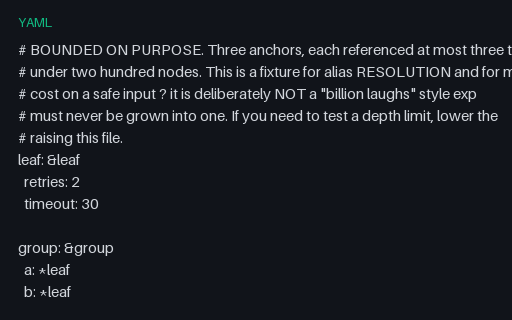
- yamlYAML Bounded Anchor ReuseNested anchor reuse kept deliberately small: two anchors, six references, thirty-one expanded nodes. It is here to test alias resolution and expansion accounting on a safe input, and is explicitly not a billion-laughs expansion bomb.
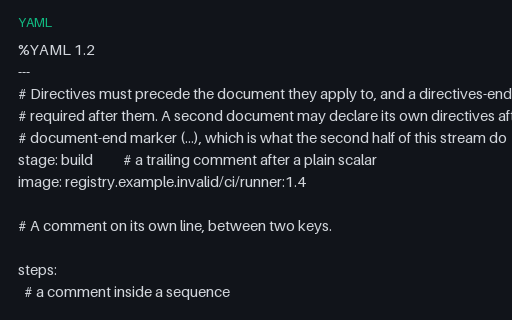
- yamlYAML Directives and CommentsA two-document stream where each document declares its own %YAML directive and the second adds a %TAG handle used by a local tag. Comments appear in every position they are legal, and every one of them is lost by a non-round-tripping loader.
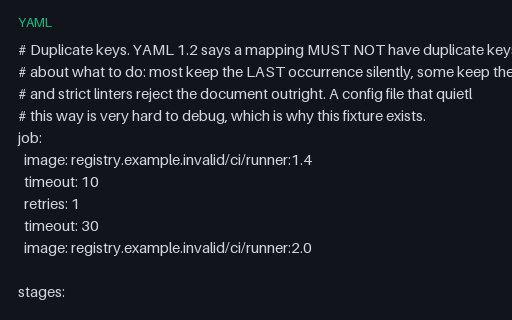
- yamlYAML Duplicate KeysDuplicate keys at three nesting levels, including a duplicated top-level sequence. The spec forbids them; most loaders keep the last silently, a few keep the first, and strict linters reject the document. The file publishes the last-wins answer.
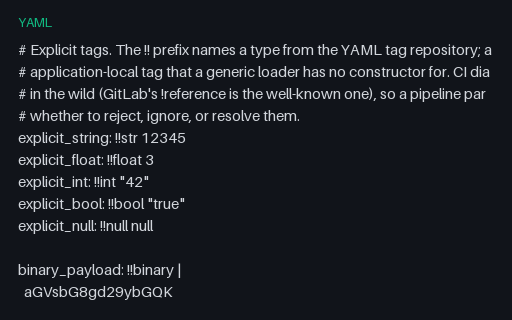
- yamlYAML Explicit and Local TagsExplicit tags across the standard set (!!str, !!float, !!int, !!bool, !!null, !!binary, !!timestamp, !!omap, !!set) alongside two application-local ! tags. CI dialects use local tags in the wild, so a pipeline parser has to decide whether to reject, ignore, or resolve them.