Scanner Report, Truncated: Intentionally Corrupt
An intentionally corrupt scanner report: a valid Trivy-shaped JSON document cut off inside the first finding, for testing that a CI gate fails the build rather than reporting zero vulnerabilities. Advisory identifiers use the invented NOVUS-SAMPLE namespace with SAMPLE-CVE aliases; no identifier here refers to a published CVE, GHSA or OSV record, and no package named exists.
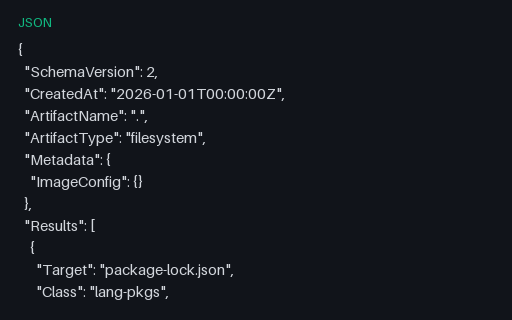
{
  "SchemaVersion": 2,
  "CreatedAt": "2026-01-01T00:00:00Z",
  "ArtifactName": ".",
  "ArtifactType": "filesystem",
  "Metadata": {
    "ImageConfig": {}
  },
  "Results": [
    {
      "Target": "package-lock.json",
      "Class": "lang-pkgs",
      "Type": "npm",
      "Vulnerabilities": [
        {
          "VulnerabilityID": "NOVUS-SAMPLE-2026-0001",
          "PkgName": "example-logger",
          "PkgIdentifier": {
            "PURL": "pkg:npm/example-logger@3.4.1"
          },
          "InstalledVersion": "3.4.1",
          "FixedVersion": "3.5.0",
          "Status": "fixed",
          "SeveritySource": "novus-sample",
          "PrimaryURL": "https://advisories.orchard.example/NOVUS-SAMPLE-2026-0001",
          "Title": "SAMPLE advisory: fabricated improper-input-validation issue in a fictional logging library.",
          "Description": "SAMPLE advisory: fabricated improper
Specifications
- Seed
- 51200
- Sample Only
- true
- Scanner
- Trivy-shaped
- Damage
- truncated mid-finding
- Intentionally Corrupt
- true
- Line Endings
- LF
Testing contract
Expected to fail- Scenario
- Feed a CI security gate a report that was truncated by a killed scanner.
- Expected result
- The gate errors on unparseable input instead of interpreting the failure as a clean scan and letting the build pass.
What is a .json file?
JSON (JavaScript Object Notation) is a lightweight, text-based data-interchange format representing objects, arrays, strings, numbers, booleans, and null. It is language-independent, human-readable, and the dominant format for web APIs and configuration. It requires a single well-formed root value.
How to use this file
Use an example JSON file to test parsers and serializers, schema validation, Unicode and number-precision handling, and API request or response processing.
How to use this file for testing
“Scanner Report, Truncated: Intentionally Corrupt” is a deterministic Testaroo fixture for Error handling, JSON parsing. Deliberately corrupt and invalid files, clearly labelled, for testing how your tool fails.
Documented properties for this file: seed 51200 · damage: truncated mid-finding · LF · intentionally corrupt. Compare results against paired or grouped companions on this page when present (clean↔damaged, searchable↔scanned, or format twins) so scores stay reproducible across runs.
Download the file once, keep the path stable in CI or local scripts, and treat the spec table as the contract: dimensions, seeds, field lists, and roles are intentional. Corrupt or invalid samples are labelled as such, expect parsers to fail loudly rather than silently accept them.
SBOM, lockfile, provenance, and advisory fixtures describe the same fabricated component tree across formats, so a converter or scanner can be diffed against a known answer. Every package name, version, hash, and advisory ID is invented, never treat a finding here as real.
Code examples
import json

with open("trivy-report-truncated.json") as f:
    data = json.load(f)
print(type(data), len(data))
Generated by generation/supply_chain.py. Free for any use, no attribution required, license.
Related files
- jsonDependency Alerts Feed (JSON)The shape a hosted dependency-alert API returns: alerts with lifecycle state, a nested advisory, a patched-version pointer and an explicitly null dismissed_reason on the alerts that were not dismissed. Advisory identifiers use the invented NOVUS-SAMPLE namespace with SAMPLE-CVE aliases; no identifier here refers to a published CVE, GHSA or OSV record, and no package named exists.
- jsonnpm audit Report (v1, Legacy Shape)The legacy npm audit shape (numeric advisory ids, a separate actions array and dependency paths written with '>'), which tools built for the v2 report silently read as zero findings. Advisory identifiers use the invented NOVUS-SAMPLE namespace with SAMPLE-CVE aliases; no identifier here refers to a published CVE, GHSA or OSV record, and no package named exists.
- jsonpip-audit Report (JSON)A pip-audit report for the fictional Python packages. It deliberately carries no severity field (pip-audit does not assign one), which is the case a severity gate must handle without defaulting to critical. Advisory identifiers use the invented NOVUS-SAMPLE namespace with SAMPLE-CVE aliases; no identifier here refers to a published CVE, GHSA or OSV record, and no package named exists.
- jsonTrivy Clean Scan Report (Zero Findings)A clean scan report: the case dashboards get wrong. Trivy omits the Vulnerabilities key entirely rather than emitting an empty array, so a reader that assumes the key exists throws on a passing build. Advisory identifiers use the invented NOVUS-SAMPLE namespace with SAMPLE-CVE aliases; no identifier here refers to a published CVE, GHSA or OSV record, and no package named exists.
- jsonTrivy Container Image Scan Report (JSON)A Trivy-shaped image report with three result blocks (OS packages, language packages and a Dockerfile misconfiguration), so a parser must handle a Results array whose members have different keys. Advisory identifiers use the invented NOVUS-SAMPLE namespace with SAMPLE-CVE aliases; no identifier here refers to a published CVE, GHSA or OSV record, and no package named exists.
- jsonCycloneDX 1.6 Minimal SBOM (One Component)The smallest CycloneDX document that is still valid: required metadata, one fictional component, and no dependencies array, for testing that a reader handles an SBOM with nothing optional present. Every package, version, hash and licence is fictional: the tree describes nothing real.