SCTE-35: Splice Insert (Break Start)
An SCTE-35 splice_insert as XML: the cue that tells a downstream packager a linear ad break starts. outOfNetworkIndicator marks entry into the break, ptsTime is 8 seconds on the 90 kHz PTS clock, and the 30-second break auto-returns. This is the signal a manifest manipulator converts into an HLS EXT-X-CUE-OUT or a new DASH period.
<?xml version="1.0" encoding="UTF-8"?>
<SpliceInfoSection xmlns="http://www.scte.org/schemas/35" protocolVersion="0" ptsAdjustment="0"
                   tier="4095" sapType="3">
  <SpliceInsert spliceEventId="1001" spliceEventCancelIndicator="false" outOfNetworkIndicator="true"
                spliceImmediateFlag="false" uniqueProgramId="1" availNum="1" availsExpected="1">
    <Program><SpliceTime ptsTime="720000"/></Program>
    <BreakDuration autoReturn="true" duration="2700000"/>
  </SpliceInsert>
</SpliceInfoSection>
Specifications
- Standard
- SCTE-35
- Command
- splice_insert
- Splice Event Id
- 1001
- Out Of Network
- true: entering the break
- Pts Time
- 720000 (8.0s at 90 kHz)
- Break Duration
- 2700000 (30.0s at 90 kHz)
- Auto Return
- true
- Alt Text
- An SCTE-35 splice_insert as XML: the cue that tells a downstream packager a linear ad break starts
- Alt Text Source
- description
Testing contract
Expected to pass- Scenario
- Parse the SCTE-35 message and compute the wall-clock start and end of the break it signals.
- Expected result
- A `splice_insert` command, splice event ID 1001, `outOfNetwork` true, PTS time 720000 (8.0s at 90 kHz) with a break duration of 2700000 (30.0s) and `autoReturn` true. The 90 kHz clock is the assertion: dividing by 90000 is required to reach seconds, and `autoReturn` means the return to network is implied rather than separately signalled.
What is a .xml file?
XML (Extensible Markup Language) is a verbose, self-describing markup language using nested tags, attributes, and namespaces to represent structured, hierarchical data. It supports schemas, entities, and validation and underlies many document and data formats. It remains common in enterprise, publishing, and interchange contexts.
How to use this file
Use an example XML file to test parsers, namespace and schema validation, XPath queries, and protection against entity-expansion and external-entity attacks.
How to use this file for testing
“SCTE-35: Splice Insert (Break Start)” is a deterministic Testaroo fixture for Ad insertion, Streaming manifests, Video QA. VAST ad responses and SCTE-35 splice descriptors covering linear break signalling, wrappers, and companion creatives, for testing ad-decision integration and manifest-manipulation logic without calling a real ad server.
Documented properties for this file: XML · 528 bytes. Compare results against paired or grouped companions on this page when present (clean↔damaged, searchable↔scanned, or format twins) so scores stay reproducible across runs.
Download the file once, keep the path stable in CI or local scripts, and treat the spec table as the contract: dimensions, seeds, field lists, and roles are intentional. Corrupt or invalid samples are labelled as such, expect parsers to fail loudly rather than silently accept them.
Media fixtures are short and synthetic by design. Prefer waveform or transcript ground truth in the same group when measuring ASR, trim, upscale, or sync tools; do not assume broadcast-quality masters.
Code examples
import xml.etree.ElementTree as ET

tree = ET.parse("scte35-splice-insert.xml")
root = tree.getroot()
print(root.tag, [c.tag for c in root][:5])
Generated by generation/video_timedtext.py. Free for any use, no attribution required, license.
Related files
- m4sDASH VOD: Init Segment (init-stream0.m4s)A DASH initialisation segment carrying codec configuration for one representation. Named by the manifest's $RepresentationID$ template, so this file also exercises whether a client resolves template variables correctly rather than pattern-matching filenames.
- m4sDASH VOD: Init Segment (init-stream1.m4s)A DASH initialisation segment carrying codec configuration for one representation. Named by the manifest's $RepresentationID$ template, so this file also exercises whether a client resolves template variables correctly rather than pattern-matching filenames.
- m4sDASH VOD: Init Segment (init-stream2.m4s)A DASH initialisation segment carrying codec configuration for one representation. Named by the manifest's $RepresentationID$ template, so this file also exercises whether a client resolves template variables correctly rather than pattern-matching filenames.
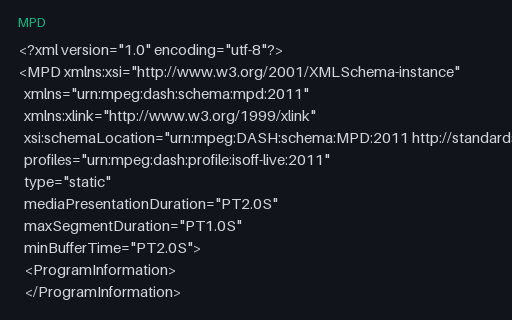
- mpdDASH VOD: Manifest (Playable Package)A complete, playable MPEG-DASH manifest for the same 320x180 at 300 kbps, 480x270 at 700 kbps, 640x360 at 1400 kbps ladder as the HLS package, produced from the same encoder run, so the two can be compared directly as packaging rather than as content. Every segment it references exists in this group. Served inline as application/dash+xml with permissive CORS, so dash.js can load it cross-origin.
- m4sDASH VOD: Media Segment (chunk-stream0-00001.m4s)A one-second DASH media segment, addressed by the manifest's $Number$ template. The same underlying CMAF structure as the HLS segments in the sibling package, which is the whole point of CMAF, and something a fixture set should let you verify rather than take on trust.
- m4sDASH VOD: Media Segment (chunk-stream0-00002.m4s)A one-second DASH media segment, addressed by the manifest's $Number$ template. The same underlying CMAF structure as the HLS segments in the sibling package, which is the whole point of CMAF, and something a fixture set should let you verify rather than take on trust.