Find files, editable templates and browser test targets by what you need to make or test. The directory below is cut by format; the two collections under it cut the same library by subject and by workflow.
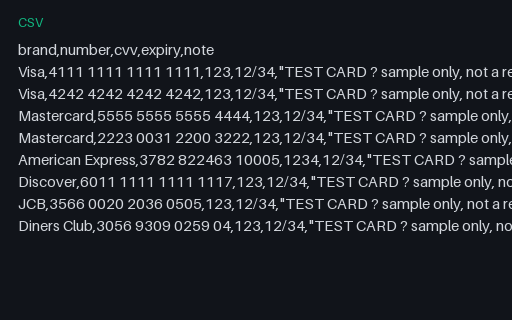
A reference list of well-known payment TEST card numbers (Visa, Mastercard, Amex, Discover, JCB, Diners) with sample CVV and expiry. These are published test values that pass the Luhn check but are not real accounts, for testing payment forms and card validators. Never use real card data.
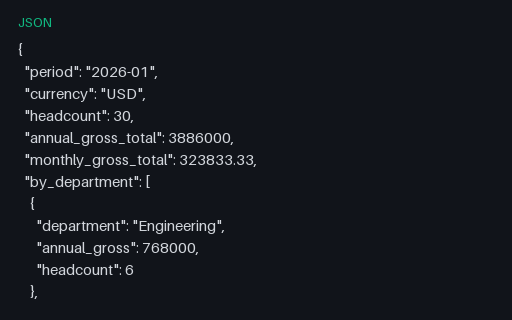
A monthly payroll summary derived from the employee directory: headcount, annual and monthly gross totals, and a per-department breakdown. A fixture for testing finance/HR dashboards and JSON aggregation.
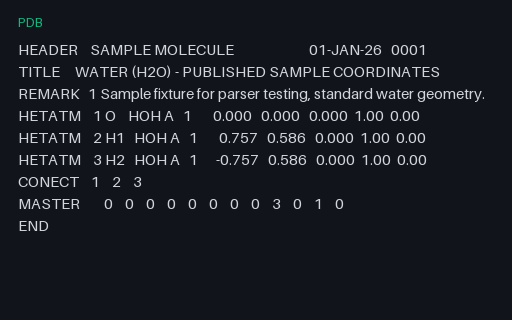
The same water molecule in PDB format with fixed-column HETATM coordinate records and a CONECT bond record, for testing molecular-structure parsers and viewers and PDB/MOL conversion.
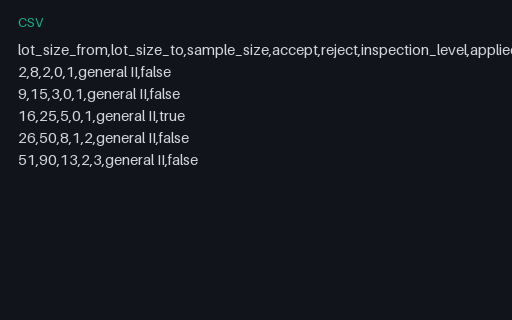
Attribute sampling plan for Pine Assembly Workshop. The sampling table the inspection used. The lot of 16 legs, being the quantity issued to BUILD-1 and BUILD-2 together, falls in the 16 to 25 band, which calls for a sample of 5 and an accept number of 0, and 5 is exactly the number of samples inspection-measurements.csv holds for each characteristic. With an accept number of 0 and 2 nonconforming readings, the lot is rejected on the plan and dealt with by nonconformance rather than by acceptance.
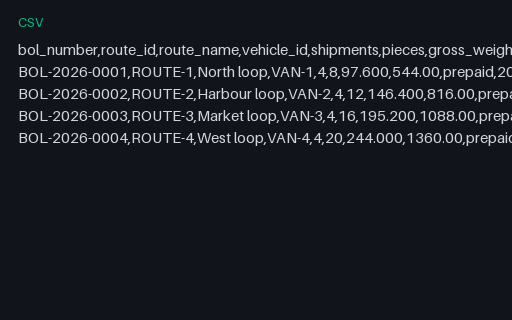
Bill of lading register for Pine Assembly Workshop. 4 bills of lading, one per delivery round, covering all 16 shipments and all 56 pieces. The piece counts are 8, 12, 16, 20 and they sum to 56, which is the parcels column of shipments-export.csv. Freight terms are prepaid on every round.
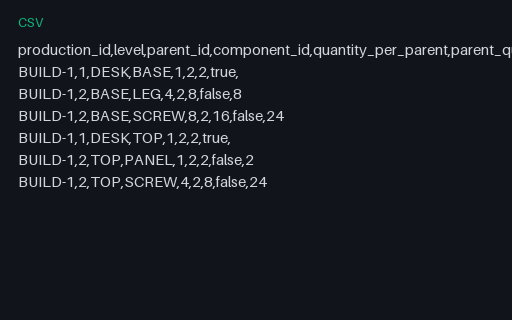
Bill of materials exploded for a production order for Pine Assembly Workshop. The same structure exploded for BUILD-1, an order for 2 DESK. Extended quantity is quantity per parent times parent quantity on every row, and the leaf totals of 8 LEG, 2 PANEL and 24 SCREW equal the material requirements the inventory-manufacturing model already holds for that order, which the model_requirement column repeats on each leaf row for comparison.
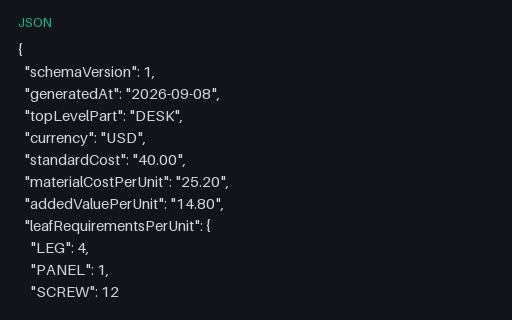
Bill of materials JSON for Pine Assembly Workshop. The DESK structure as a flat array with level, parent and both quantities, plus the cost identity at the top: 25.20 USD of leaf material plus 14.80 USD of added value is the 40.00 USD standard cost the parts table holds. A reader can rebuild the tree from parent and component without needing the indent string the CSV carries.
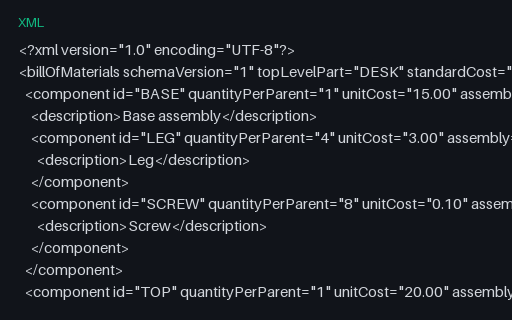
Bill of materials XML for Pine Assembly Workshop. The same structure as genuinely nested XML rather than a flat list with a level column, so a reader has to walk the tree and multiply quantities down the path to reach a leaf requirement. SCREW appears in two different branches with different quantities per parent, 8 under BASE and 4 under TOP.
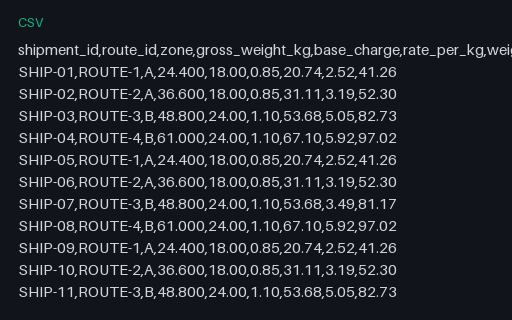
Carrier invoice whose fuel surcharge uses the wrong basis on one line for Pine Assembly Workshop. The 13 billable shipments with a TOTAL row. Every line is correct except SHIP-07, whose fuel_surcharge was computed on the weight charge alone: 53.68 times 0.065 gives 3.49 instead of 5.05 on the base plus weight charge. The line is 1.56 light and the TOTAL row reads 859.63 against the correct 861.19.
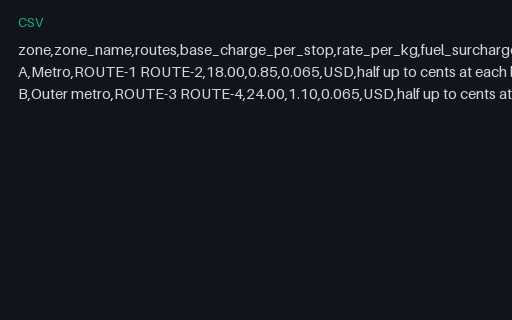
Carrier rate sheet for Pine Assembly Workshop. Two delivery zones. Zone A covers ROUTE-1 ROUTE-2 at 18.00 per stop plus 0.85 per kg; zone B covers ROUTE-3 ROUTE-4 at 24.00 per stop plus 1.10 per kg. A fuel surcharge of 0.065 applies to the base plus the weight charge, and every line rounds half up to cents.
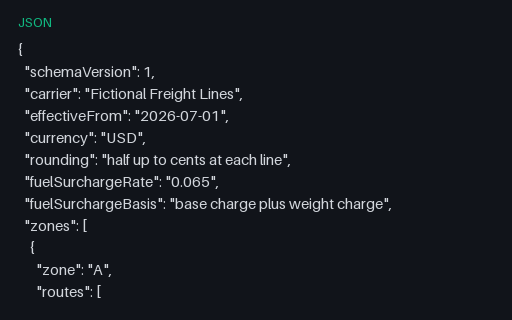
Carrier rate sheet JSON for Pine Assembly Workshop. The same two zones as rate-sheet.csv with the rating formula written out as a string, including the fact that the fuel surcharge applies to the base charge as well as the weight charge. That basis is the one most often got wrong.