Find files, editable templates and browser test targets by what you need to make or test. The directory below is cut by format; the two collections under it cut the same library by subject and by workflow.
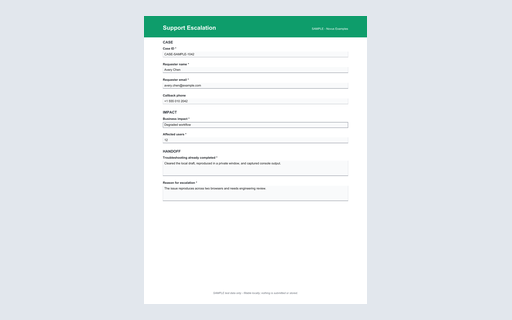
A one-page fillable PDF twin of the support escalation HTML form. Its canonical AcroForm field tree, widgets, values, and appearance streams are generator-validated.
A level-one to specialist support handoff for testing ticket escalation, impact classification, troubleshooting history, and callback-field imports. This standalone HTML reference works offline, uses explicit labels and native validation, and submits nowhere.
All five temporal HTML input types with explicit bounds and sample values, including the two that many form libraries silently downgrade to plain text - month and week - so a round trip can be verified format by format.
The six textual HTML input types on a single page, each with the autocomplete token and validation attributes it normally carries, so a parser can be checked type by type rather than against a mixed realistic form.
A leave request where the second date must not precede the first and the working-day count is computed in the browser. The cross-field date rule is the constraint HTML cannot express, which makes it a useful validator fixture.
A second-factor enrolment flow covering the three common methods and the six-digit confirmation control that carries the one-time-code autofill token. No code is generated and nothing is verified.
Control names and labels outside ASCII, including a combining-accent pair that is visually identical to a precomposed one. A form parser that normalises names, or that assumes ASCII, produces a different key set from one that does not.
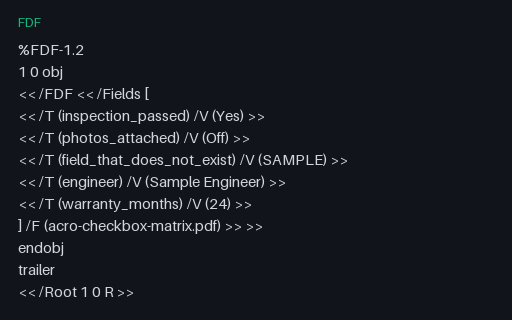
Intentionally corrupt. An FDF bound to acro-checkbox-matrix.pdf that sets two fields the PDF does not define and omits four that it does. A filler should report the unknown names rather than discard them silently.
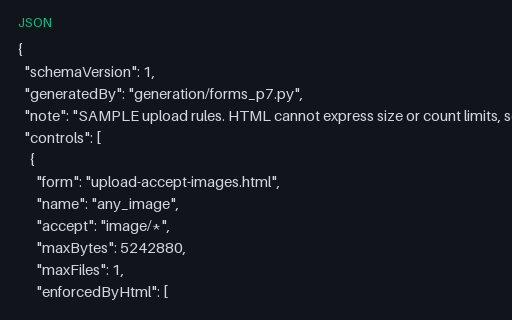
Size and count limits for every file control in this wave, together with the rejection codes an application would return. HTML expresses none of these, so the manifest is where they have to live.
Document accept lists including the verbose OpenXML media types that are the usual source of accept-attribute mistakes, plus a control that pairs a media type with the matching extension so both matching strategies succeed.
A drop surface that lists filenames in the browser, layered over a real file input so keyboard and assistive-technology users reach the same control. Useful for testing automation that has to choose between synthesising a drop event and setting the input directly.
Four file controls whose accept expressions narrow the picker in different ways: a wildcard media type, an explicit list of media types, an extension list, and a capture hint that asks a phone for the camera rather than the gallery.