Find files, editable templates and browser test targets by what you need to make or test. The directory below is cut by format; the two collections under it cut the same library by subject and by workflow.
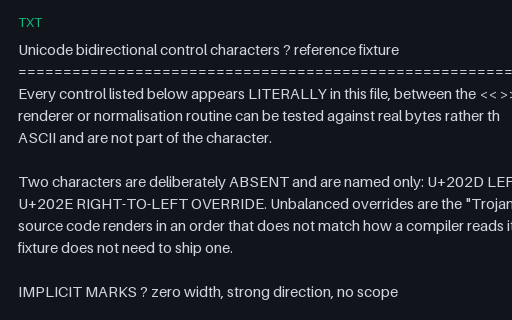
A reference sheet in which each of the ten shipped bidi control characters appears literally between ASCII guards, with its code point, UTF-8 bytes and the job it does. The two override characters are named but deliberately absent: a bidi rendering fixture does not need to ship the Trojan Source vector.
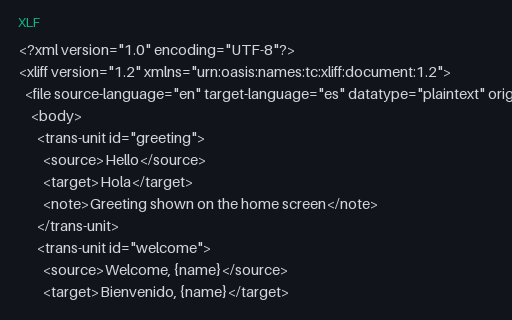
An OASIS XLIFF 1.2 file with English source and Spanish target trans-units and notes: the classic interchange format between authoring tools and translation-management systems.
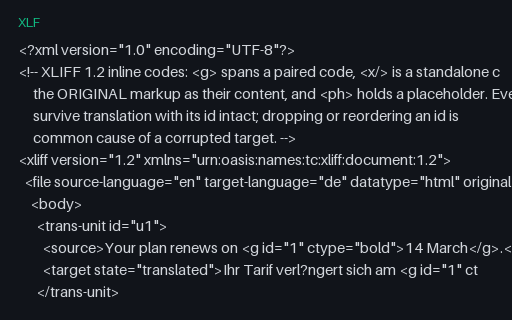
The XLIFF 1.2 half of a version twin covering how each version represents inline markup and placeholders. XLIFF 1.2 keeps the original markup inline in <bpt>/<ept> and uses <g>, <x/> and <ph>; XLIFF 2.0 replaced all of them with <pc>, <ph/>, <sc/>/<ec/> and moved the markup into an <originalData> block referenced by id.
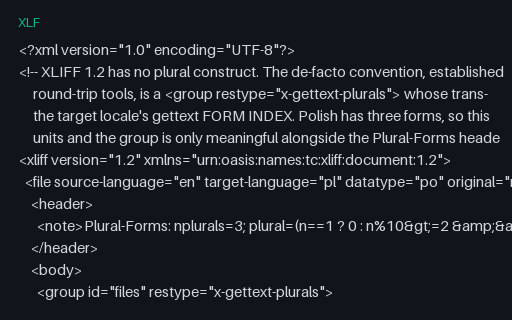
The XLIFF 1.2 half of a version twin covering how each version expresses a plural group. XLIFF 1.2 uses a <group restype="x-gettext-plurals"> whose trans-units are ordered by gettext form index; XLIFF 2.0 dropped restype, so the same content becomes one <unit> per CLDR category, named by category rather than by index.
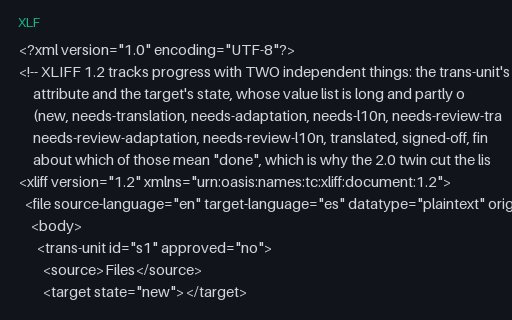
The XLIFF 1.2 half of a version twin covering how each version records translation progress. XLIFF 1.2 has approved="yes|no" plus a ten-value target state; XLIFF 2.0 removed approved and cut the vocabulary to four ordered values (initial, translated, reviewed, final) with everything else pushed into a namespaced subState.
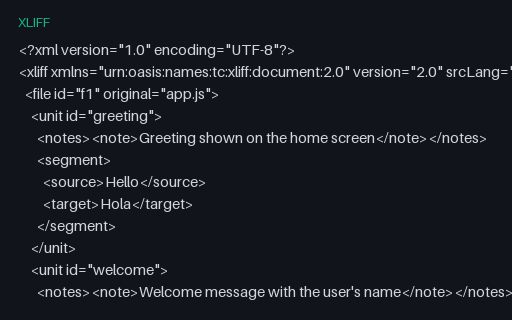
An OASIS XLIFF 2.0 file with the same content as its 1.2 twin, using the modern unit/segment structure, for testing XLIFF 2.0 parsers and 1.2-to-2.0 converters.
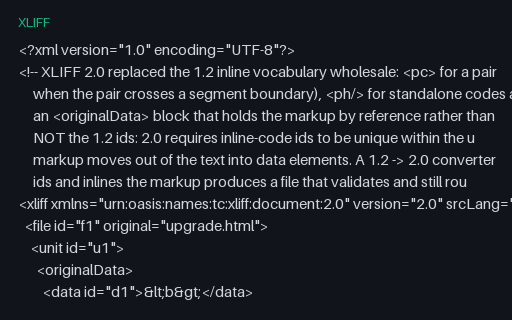
The XLIFF 2.0 half of a version twin covering how each version represents inline markup and placeholders. XLIFF 1.2 keeps the original markup inline in <bpt>/<ept> and uses <g>, <x/> and <ph>; XLIFF 2.0 replaced all of them with <pc>, <ph/>, <sc/>/<ec/> and moved the markup into an <originalData> block referenced by id.
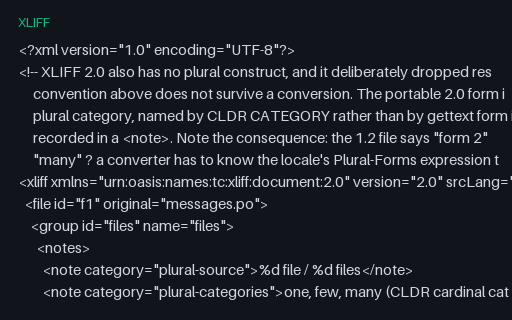
The XLIFF 2.0 half of a version twin covering how each version expresses a plural group. XLIFF 1.2 uses a <group restype="x-gettext-plurals"> whose trans-units are ordered by gettext form index; XLIFF 2.0 dropped restype, so the same content becomes one <unit> per CLDR category, named by category rather than by index.
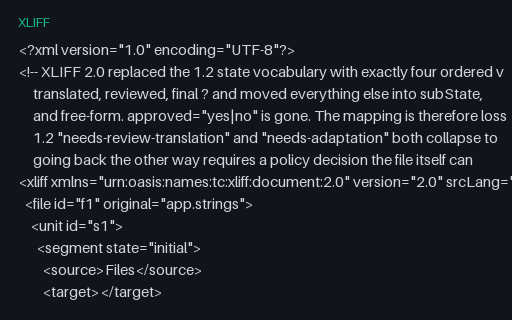
The XLIFF 2.0 half of a version twin covering how each version records translation progress. XLIFF 1.2 has approved="yes|no" plus a ten-value target state; XLIFF 2.0 removed approved and cut the vocabulary to four ordered values (initial, translated, reviewed, final) with everything else pushed into a namespaced subState.