MessagePack: Binary JSON
The records as MessagePack: a compact binary serialization that maps onto the JSON data model, common in caches and RPC. For testing MessagePack codecs and JSON↔MessagePack conversion.
| idint64 | namestring | emailstring | departmentstring | activebool | scoredouble | joineddate |
|---|---|---|---|---|---|---|
| 1001 | Ada Lovelace | ada.lovelace@example.com | Engineering | true | 98.5 | 2021-03-01 |
| 1002 | Alan Turing | alan.turing@example.com | Research | true | 95 | 2020-06-15 |
| 1003 | Grace Hopper | grace.hopper@example.com | Engineering | false | 91.2 | 2019-11-20 |
| 1004 | Katherine Johnson | katherine.johnson@example.com | Operations | true | 96.8 | 2022-01-10 |
| 1005 | Edsger Dijkstra | edsger.dijkstra@example.com | Research | false | 89.4 | 2018-09-05 |
Specifications
- Rows
- 5
- Columns
- 7
- Format
- MessagePack
- Model
- document
Testing contract
Expected to pass- Scenario
- Exercise MessagePack: Binary JSON in its binary workflow. The records as MessagePack: a compact binary serialization that maps onto the JSON data model, common in caches and RPC.
- Expected result
- root type=dict; root item count=1; first keys/values=['employees']. Declared feature checks: columns=7; model=document.
What is a .msgpack file?
MessagePack (.msgpack) is a compact binary serialization format, like JSON but smaller and faster, that encodes maps, arrays, strings, numbers, and binary blobs in a self-describing byte stream. It is popular for caching, IPC, and network protocols.
How to use this file
Use an example .msgpack file to test MessagePack decoders and MessagePack-to-JSON converters, or to verify binary round-trips.
How to use this file for testing
“MessagePack: Binary JSON” is a deterministic Testaroo fixture for Conversion testing, Serialization testing. The same content exported across many formats and linked as a group, so you can convert one and diff against the expected twin.
Documented properties for this file: 5 rows · 7 columns · MessagePack. Compare results against paired or grouped companions on this page when present (clean↔damaged, searchable↔scanned, or format twins) so scores stay reproducible across runs.
Download the file once, keep the path stable in CI or local scripts, and treat the spec table as the contract: dimensions, seeds, field lists, and roles are intentional. Corrupt or invalid samples are labelled as such, expect parsers to fail loudly rather than silently accept them.
Data fixtures document their exact quirks (delimiters, encodings, null handling, schema, and row counts) in the spec table. Point your parser or importer at the file and assert it handles the documented edge cases; clean and deliberately-messy siblings make before/after diffs straightforward.
Generated by generation/data_binary.py. Free for any use, no attribution required, license.
Related files
- pbProtobuf: Encoded MessageA single protobuf User message in binary wire format (varint + length-delimited fields): the serialized counterpart to the user.proto schema. For testing protobuf decoders without the generated code.
- orcConvert v2 ORC Employee Table SourceBinary orc source for the five-row P8 employee conversion table, preserving ids, names, departments, booleans, and scores. Stable P8 artifact p8-convert-orc-source.
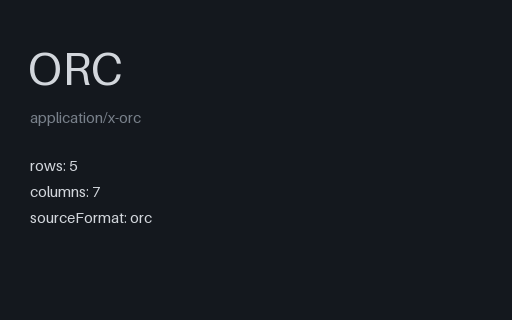
- csvConvert v2 ORC Expected CSVCsv semantic reference for the five-row P8 employee conversion table, preserving ids, names, departments, booleans, and scores. Stable P8 artifact p8-convert-orc-csv.
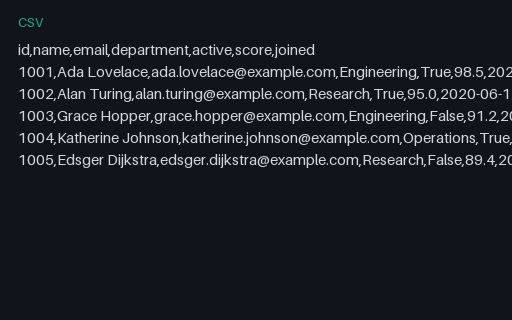
- jsonConvert v2 ORC Expected JSONJson semantic reference for the five-row P8 employee conversion table, preserving ids, names, departments, booleans, and scores. Stable P8 artifact p8-convert-orc-json.
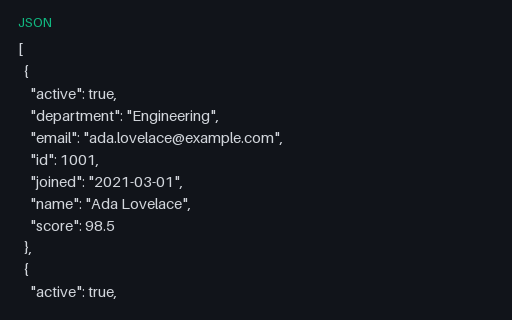
- pbConvert v2 Protobuf Creator RecordValid Protobuf wire record with string, uint32, and string fields for schema-guided decoding. Stable P8 artifact p8-convert-protobuf-source.
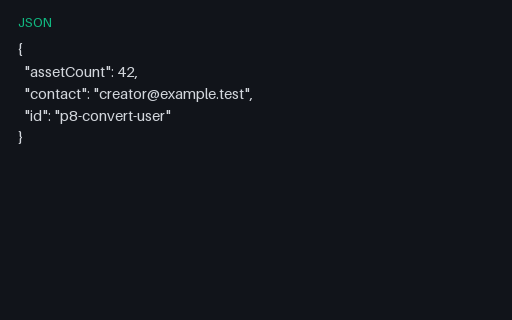
- jsonConvert v2 Protobuf Expected JSONExpected JSON semantic result for the schema-guided Protobuf decode. Stable P8 artifact p8-convert-protobuf-expected.