
xlsx
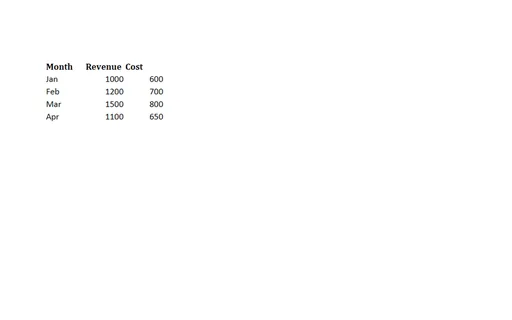
5.4 KBMulti-Sheet XLSX with Formulas
A two-sheet workbook where a Summary sheet references a Data sheet with SUM and arithmetic formulas, for testing spreadsheet parsers, formula evaluation, and converters.
- File
- XLSX · Excel
Multi-sheet workbooks with documented formulas and plain sheets for testing spreadsheet parsers and importers.
A two-sheet workbook where a Summary sheet references a Data sheet with SUM and arithmetic formulas, for testing spreadsheet parsers, formula evaluation, and converters.
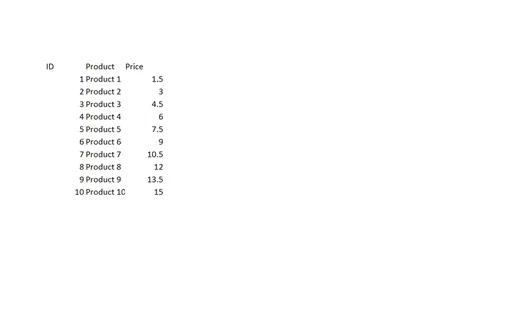
A single-sheet workbook of plain tabular values with no formulas: a baseline fixture for spreadsheet importers.
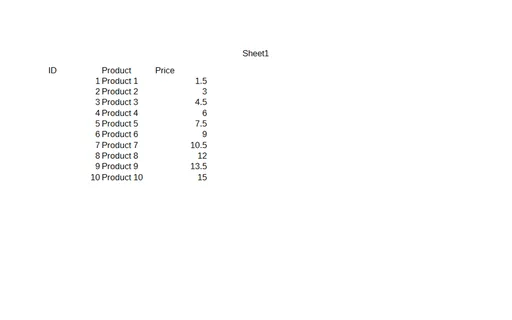
An OpenDocument Spreadsheet with the same tabular data as the plain XLSX and legacy XLS: a member of an XLSX↔ODS↔XLS conversion set for spreadsheet importers.
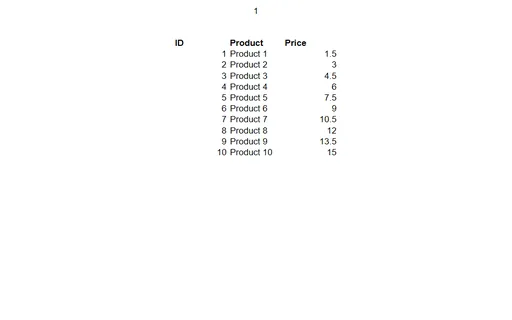
A legacy Excel 97–2003 (.xls / BIFF8) workbook holding the same tabular data as the plain XLSX and ODS, for testing legacy-format readers and XLS↔XLSX conversion.
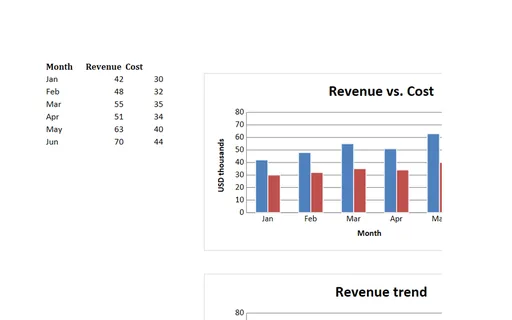
A workbook with a data table plus a native bar chart and a line chart bound to the cells, for testing whether spreadsheet parsers and XLSX-to-PDF converters preserve and render embedded charts.
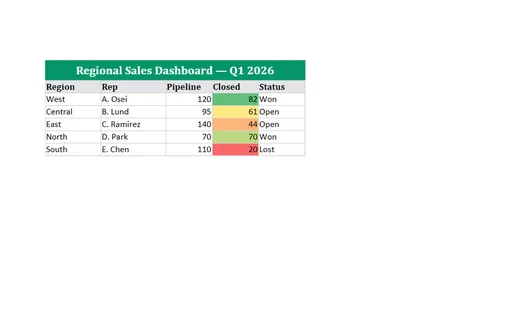
A dashboard sheet exercising the features importers miss: a merged title cell, a three-colour conditional-formatting scale, a data-validation dropdown, cell borders, and frozen panes.
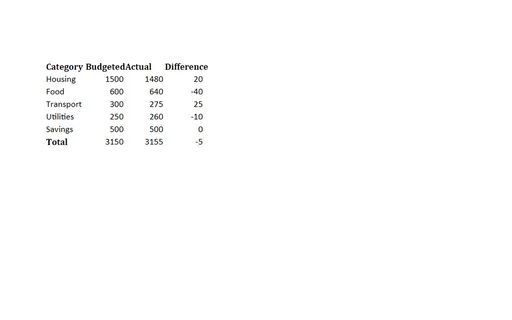
A monthly budget workbook with budgeted-vs-actual categories, per-row difference formulas, and column totals.
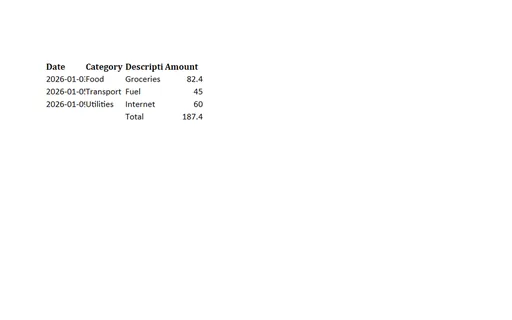
A simple expense tracker with date, category, description, amount, and a total formula.
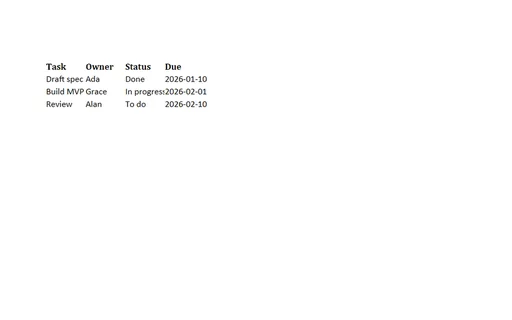
A project task list with task, owner, status, and due-date columns.
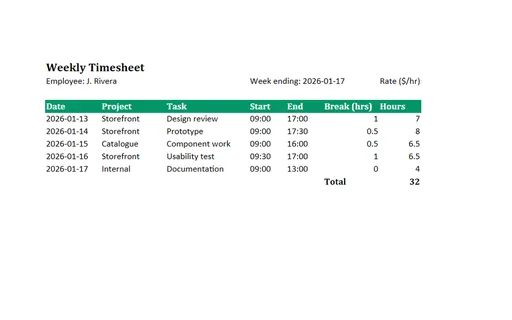
A weekly timesheet that computes hours from start and end times minus breaks, multiplies by an hourly rate for pay, and totals the week with live formulas: good for spreadsheet and formula testing.
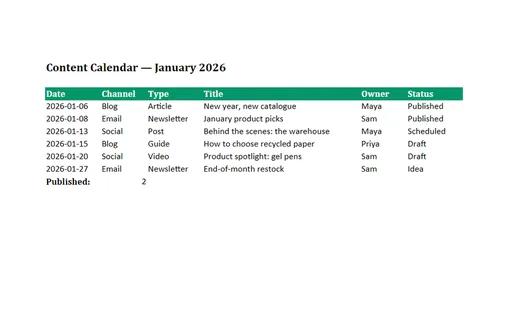
A monthly content calendar tracking posts across channels with owner and status columns and a COUNTIF that tallies published items: a realistic marketing planning sheet.
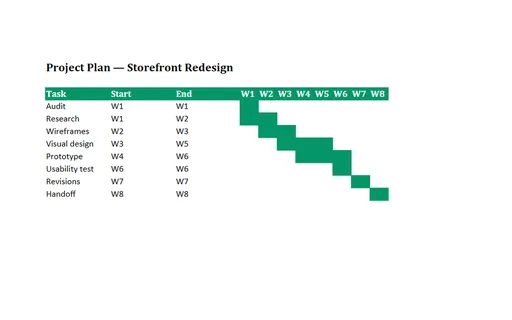
A lightweight Gantt chart: eight project tasks with start and end weeks and a coloured cell bar spanning each task's duration across an eight-week grid.
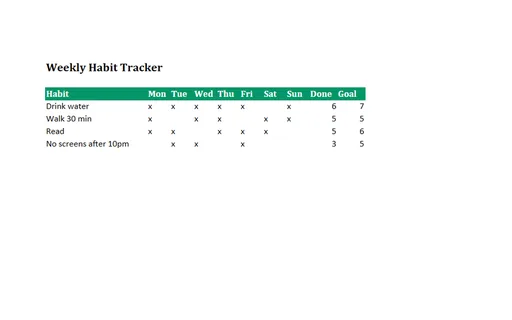
A weekly habit tracker with a checkbox grid across seven days, a COUNTIF that counts completed days, and a goal column: a simple personal planning sheet.
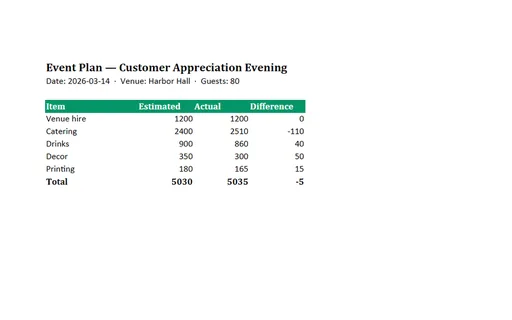
A two-sheet event planner: a budget sheet with estimated-versus-actual difference formulas and totals, plus a task sheet with owners, due dates, and status.
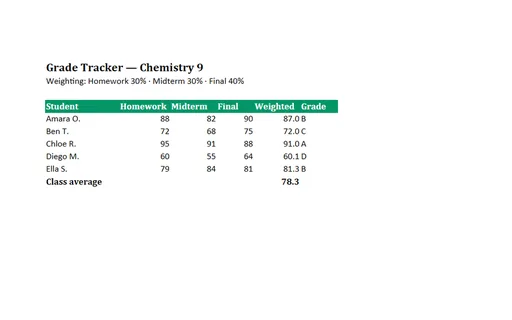
A gradebook that computes a weighted average from homework, midterm, and final scores, assigns a letter grade with nested IF, and averages the class: good for formula testing.
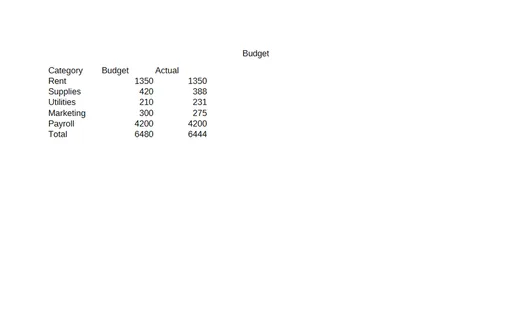
A budget template as OpenDocument Spreadsheet, budget-versus-actual rows with live SUM formulas for the totals. A usable planning template and a fixture for testing ODS formula parsing and recalculation.
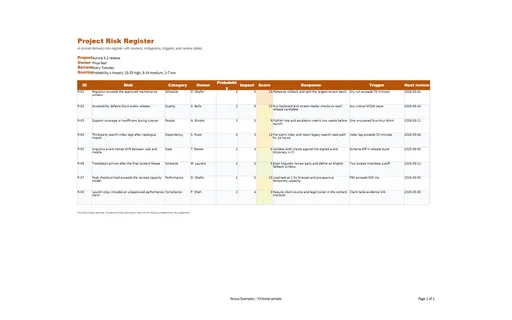
A scored delivery-risk register with owners, mitigations, triggers, and review dates. This Excel workbook adds filters, frozen headers, print settings, typed cells, and live formulas where the model defines them.
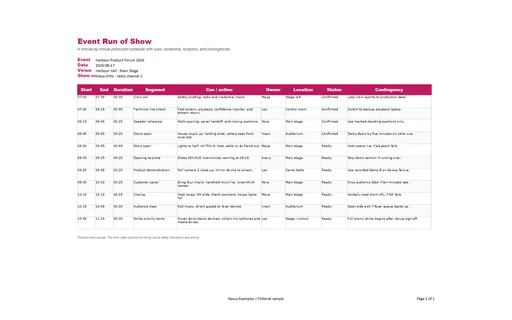
A minute-by-minute production schedule with cues, ownership, locations, and contingencies. This Excel workbook adds filters, frozen headers, print settings, typed cells, and live formulas where the model defines them.
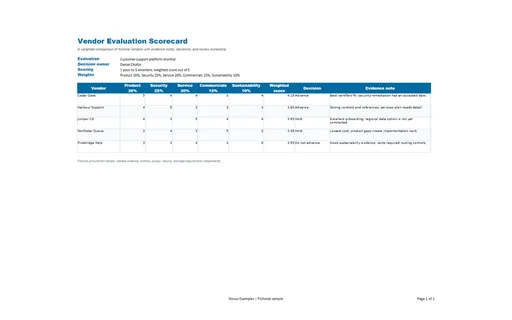
A weighted comparison of fictional vendors with evidence notes, decisions, and review ownership. This Excel workbook adds filters, frozen headers, print settings, typed cells, and live formulas where the model defines them.
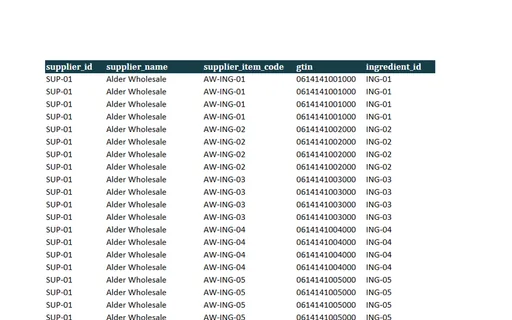
Procure-to-pay workbook for Alder Table Bistro. 9 worksheets holding the same rows as the CSV exports plus a 'Deliberate defects' sheet naming all 6: Price list 48 rows; Purchase orders 12 rows; Goods received 12 rows; Invoice lines 14 rows; Credit notes 2 rows; Statement 13 rows; Remittance 13 rows; Three-way match 14 rows; Deliberate defects 6 rows. Money cells are numbers formatted 0.00 rather than text, so a spreadsheet reader can sum a column without parsing strings.
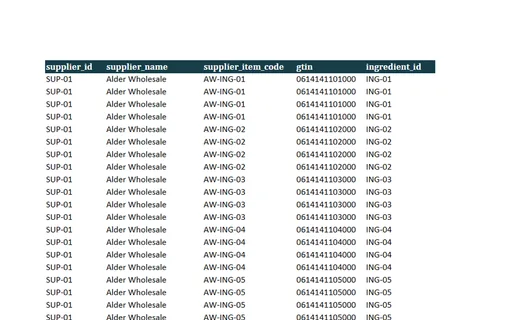
Procure-to-pay workbook for Juniper Corner Cafe. 9 worksheets holding the same rows as the CSV exports plus a 'Deliberate defects' sheet naming all 6: Price list 48 rows; Purchase orders 12 rows; Goods received 12 rows; Invoice lines 14 rows; Credit notes 2 rows; Statement 13 rows; Remittance 13 rows; Three-way match 14 rows; Deliberate defects 6 rows. Money cells are numbers formatted 0.00 rather than text, so a spreadsheet reader can sum a column without parsing strings.
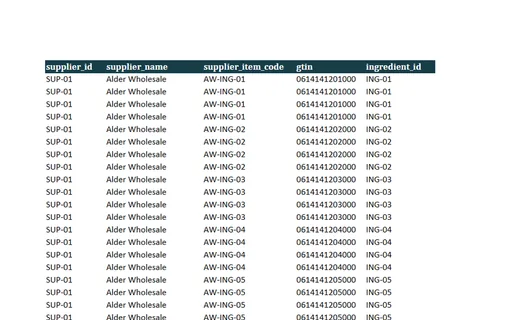
Procure-to-pay workbook for Copper Oven Bakery. 9 worksheets holding the same rows as the CSV exports plus a 'Deliberate defects' sheet naming all 6: Price list 48 rows; Purchase orders 12 rows; Goods received 12 rows; Invoice lines 14 rows; Credit notes 2 rows; Statement 13 rows; Remittance 13 rows; Three-way match 14 rows; Deliberate defects 6 rows. Money cells are numbers formatted 0.00 rather than text, so a spreadsheet reader can sum a column without parsing strings.
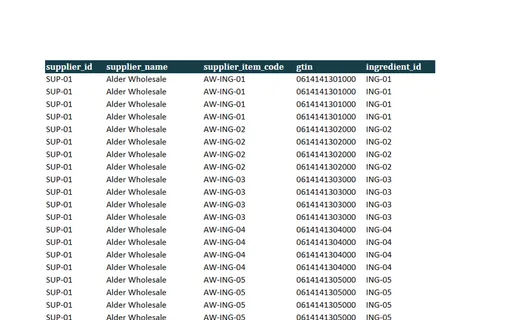
Procure-to-pay workbook for Ember Lane Pizza. 9 worksheets holding the same rows as the CSV exports plus a 'Deliberate defects' sheet naming all 6: Price list 48 rows; Purchase orders 12 rows; Goods received 12 rows; Invoice lines 14 rows; Credit notes 2 rows; Statement 13 rows; Remittance 13 rows; Three-way match 14 rows; Deliberate defects 6 rows. Money cells are numbers formatted 0.00 rather than text, so a spreadsheet reader can sum a column without parsing strings.
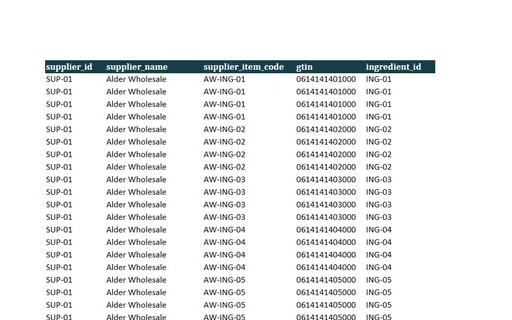
Procure-to-pay workbook for Cedar Street Tacos. 9 worksheets holding the same rows as the CSV exports plus a 'Deliberate defects' sheet naming all 6: Price list 48 rows; Purchase orders 12 rows; Goods received 12 rows; Invoice lines 14 rows; Credit notes 2 rows; Statement 13 rows; Remittance 13 rows; Three-way match 14 rows; Deliberate defects 6 rows. Money cells are numbers formatted 0.00 rather than text, so a spreadsheet reader can sum a column without parsing strings.
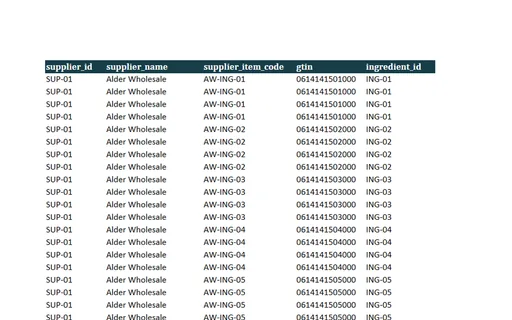
Procure-to-pay workbook for Willow Event Kitchen. 9 worksheets holding the same rows as the CSV exports plus a 'Deliberate defects' sheet naming all 6: Price list 48 rows; Purchase orders 12 rows; Goods received 12 rows; Invoice lines 14 rows; Credit notes 2 rows; Statement 13 rows; Remittance 13 rows; Three-way match 14 rows; Deliberate defects 6 rows. Money cells are numbers formatted 0.00 rather than text, so a spreadsheet reader can sum a column without parsing strings.
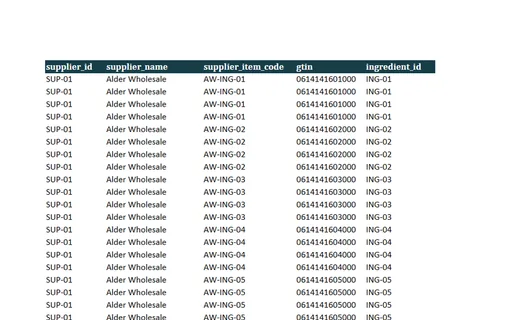
Procure-to-pay workbook for Harbour Kitchen Group. 9 worksheets holding the same rows as the CSV exports plus a 'Deliberate defects' sheet naming all 6: Price list 48 rows; Purchase orders 12 rows; Goods received 12 rows; Invoice lines 14 rows; Credit notes 2 rows; Statement 13 rows; Remittance 13 rows; Three-way match 14 rows; Deliberate defects 6 rows. Money cells are numbers formatted 0.00 rather than text, so a spreadsheet reader can sum a column without parsing strings.
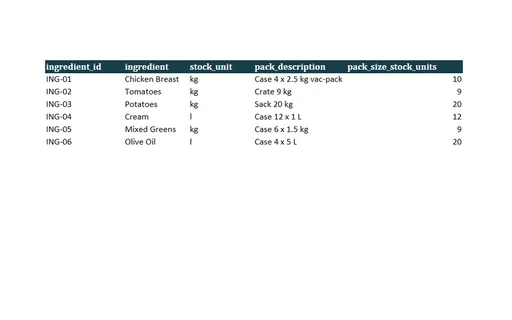
Recipe costing workbook with live formulas for Alder Table Bistro. Four sheets. Ingredients converts 6 purchase packs to a cost per recipe unit; PlateCosts holds 12 recipe lines; Summary uses SUMIF to roll each dish up and computes margin and food-cost percent; Notes records the provenance. Exactly 73 cells are live formulas with no cached value, so a values-only reader sees them empty and a recalculating reader reproduces plate-costs.csv exactly.
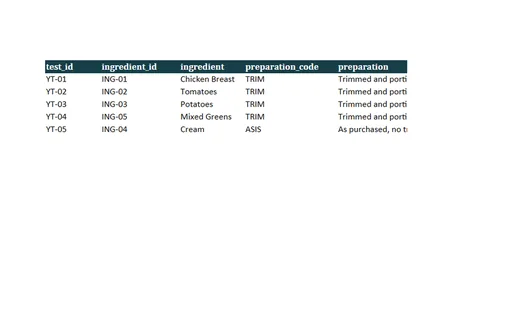
Yield test workbook with live formulas for Alder Table Bistro. 5 tests over two sheets. Trimmed weight, trim yield, cooking loss and the yield factor are formulas; the last column is an IF that compares the measured trim yield against the yield the recipe applies and writes yes or no.
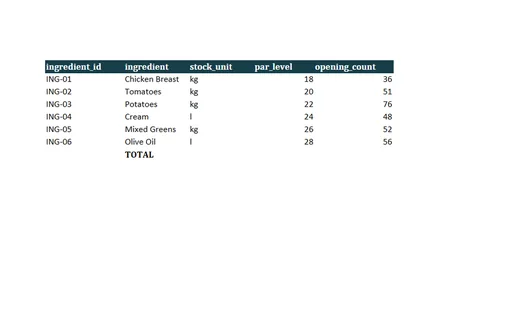
Inventory variance workbook with live formulas for Alder Table Bistro. 6 ingredients over two sheets. Theoretical closing, the variance quantity, the variance priced at standard cost, the below-par flag and the total are formulas. Theoretical usage is built from the sales table multiplied by the yield-adjusted recipe quantities, so it already carries the yield adjustment.
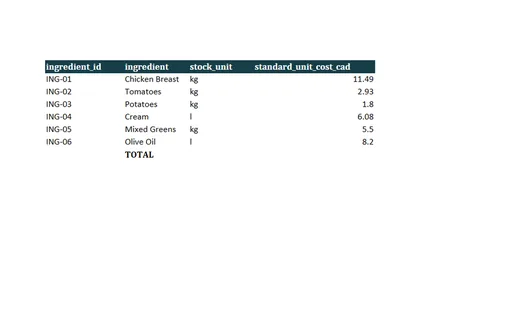
Cost of goods sold workbook with live formulas for Alder Table Bistro. Four sheets. COGS computes opening plus purchases less closing for 6 ingredients; Reconciliation proves the identity usage and waste at standard, plus the purchase price variance, less the count variance, equals the reported figure; Summary lands on 1574.81 CAD against 15780.80 CAD of net menu sales, a food cost of 9.98 percent. The purchases line is the sum of the 24 shared purchase rows dated inside 2026-08-20 to 2026-09-02.
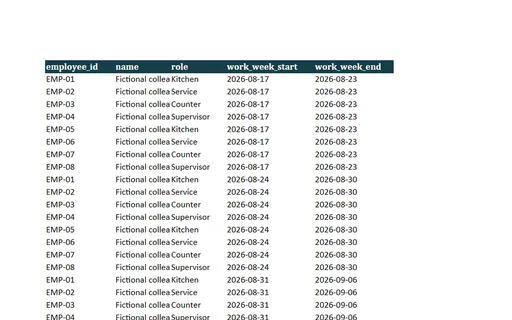
Scheduled hours and overtime workbook for Alder Table Bistro. Three sheets. WeeklyHours carries 24 employee-weeks over 3 Monday-start work weeks, with weekly overtime above 44 hours, payable overtime as the greater of the daily and weekly figures, and the premium at half the base rate. DailyHours breaks the same segments down into 59 employee-days with a daily overtime formula above 8 hours. The period carries 5.00 payable overtime hours and 51.50 CAD of premium.
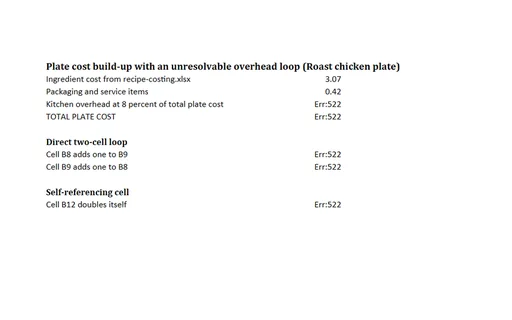
Workbook with intentional circular references for Alder Table Bistro. Intentionally circular. Two sheets. Three independent cycles: overhead in B4 is eight percent of the total in B5 while B5 adds B4 back in; B8 and B9 each add one to the other; B12 doubles itself. Every other cell is a plain value or a label, and B2 is the real plate cost of MENU-01 (Roast chicken plate) at 3.07 CAD, so the loop is the only thing wrong with the file. Measured in LibreOffice 26.2.4.2, every formula cell on the Circular sheet recalculates to Err:522.
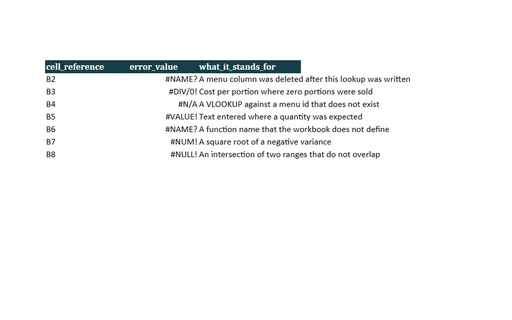
Workbook with Excel error cells for Alder Table Bistro. Intentionally full of errors. Three sheets. CachedErrors stores 7 literal error cells with the error cell type (#DIV/0!, #N/A, #NAME?, #NULL!, #NUM!, #REF!, #VALUE!), so a values-only reader still sees them. LiveFormulas holds 7 formulas that evaluate to an error on recalculation, including =SUM(#REF!) and =1/0, with no cached value. Its expected_error_excel column names Excel's value; the Notes sheet records the two cases where LibreOffice 26.2.4.2 was measured to disagree, so this file is also a fixture for cross-engine error mapping. The menu ids alongside them are real, so an importer that skips error cells has valid data left.
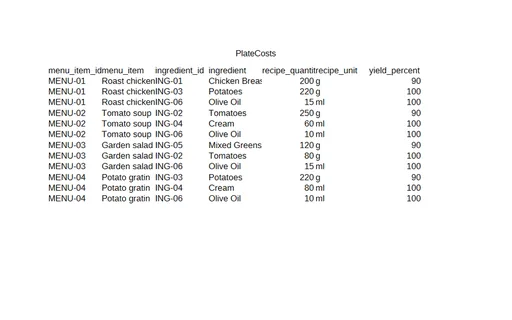
Recipe costing as an OpenDocument spreadsheet for Alder Table Bistro. Three tables. PlateCosts holds 12 recipe lines with the as-purchased quantity and line cost as live ODF formulas; Summary rolls each dish up with SUMIF and computes margin and food-cost percent. The same figures in value form are in plate-costs.csv.
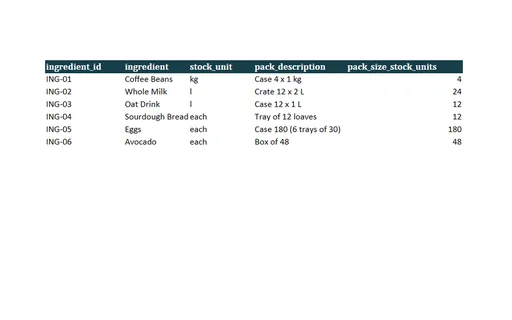
Recipe costing workbook with live formulas for Juniper Corner Cafe. Four sheets. Ingredients converts 6 purchase packs to a cost per recipe unit; PlateCosts holds 8 recipe lines; Summary uses SUMIF to roll each dish up and computes margin and food-cost percent; Notes records the provenance. Exactly 61 cells are live formulas with no cached value, so a values-only reader sees them empty and a recalculating reader reproduces plate-costs.csv exactly.
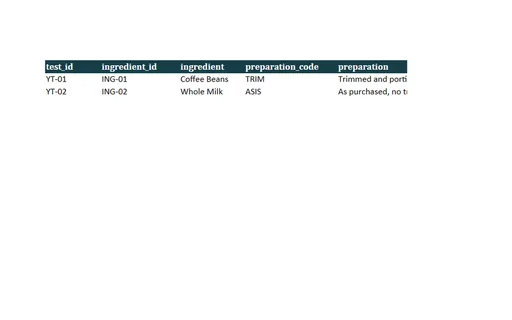
Yield test workbook with live formulas for Juniper Corner Cafe. 2 tests over two sheets. Trimmed weight, trim yield, cooking loss and the yield factor are formulas; the last column is an IF that compares the measured trim yield against the yield the recipe applies and writes yes or no.
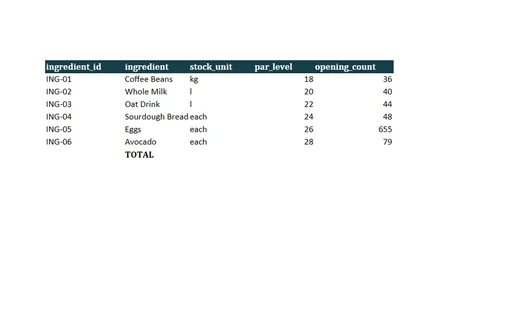
Inventory variance workbook with live formulas for Juniper Corner Cafe. 6 ingredients over two sheets. Theoretical closing, the variance quantity, the variance priced at standard cost, the below-par flag and the total are formulas. Theoretical usage is built from the sales table multiplied by the yield-adjusted recipe quantities, so it already carries the yield adjustment.
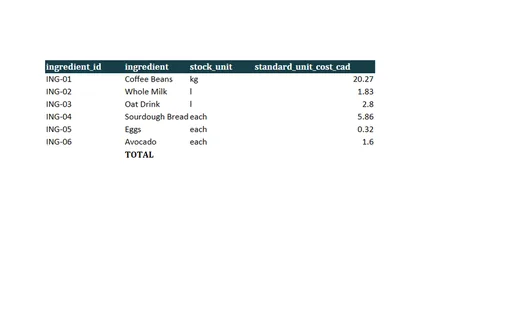
Cost of goods sold workbook with live formulas for Juniper Corner Cafe. Four sheets. COGS computes opening plus purchases less closing for 6 ingredients; Reconciliation proves the identity usage and waste at standard, plus the purchase price variance, less the count variance, equals the reported figure; Summary lands on 1538.14 CAD against 10234.74 CAD of net menu sales, a food cost of 15.03 percent. The purchases line is the sum of the 24 shared purchase rows dated inside 2026-08-20 to 2026-09-02.
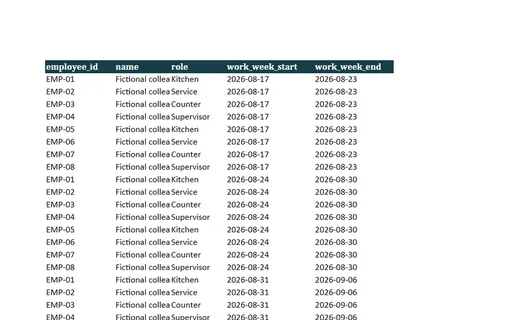
Scheduled hours and overtime workbook for Juniper Corner Cafe. Three sheets. WeeklyHours carries 24 employee-weeks over 3 Monday-start work weeks, with weekly overtime above 44 hours, payable overtime as the greater of the daily and weekly figures, and the premium at half the base rate. DailyHours breaks the same segments down into 59 employee-days with a daily overtime formula above 8 hours. The period carries 5.00 payable overtime hours and 51.50 CAD of premium.
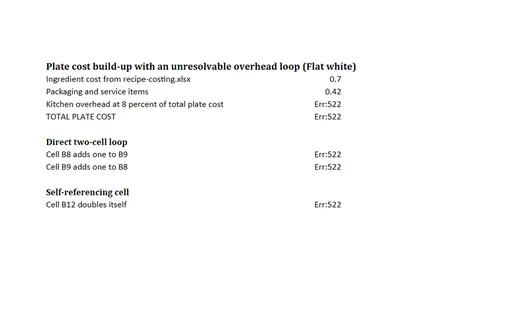
Workbook with intentional circular references for Juniper Corner Cafe. Intentionally circular. Two sheets. Three independent cycles: overhead in B4 is eight percent of the total in B5 while B5 adds B4 back in; B8 and B9 each add one to the other; B12 doubles itself. Every other cell is a plain value or a label, and B2 is the real plate cost of MENU-01 (Flat white) at 0.70 CAD, so the loop is the only thing wrong with the file. Measured in LibreOffice 26.2.4.2, every formula cell on the Circular sheet recalculates to Err:522.
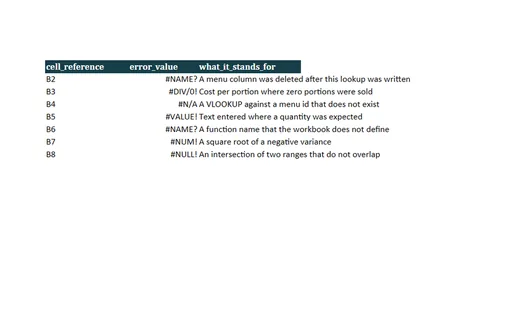
Workbook with Excel error cells for Juniper Corner Cafe. Intentionally full of errors. Three sheets. CachedErrors stores 7 literal error cells with the error cell type (#DIV/0!, #N/A, #NAME?, #NULL!, #NUM!, #REF!, #VALUE!), so a values-only reader still sees them. LiveFormulas holds 7 formulas that evaluate to an error on recalculation, including =SUM(#REF!) and =1/0, with no cached value. Its expected_error_excel column names Excel's value; the Notes sheet records the two cases where LibreOffice 26.2.4.2 was measured to disagree, so this file is also a fixture for cross-engine error mapping. The menu ids alongside them are real, so an importer that skips error cells has valid data left.
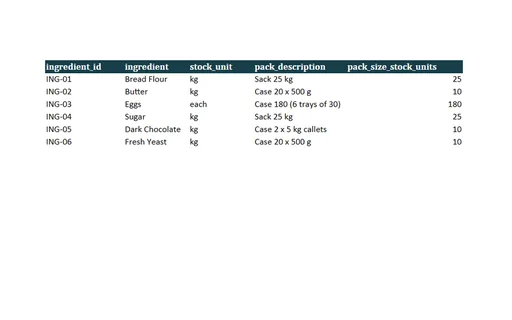
Recipe costing workbook with live formulas for Copper Oven Bakery. Four sheets. Ingredients converts 6 purchase packs to a cost per recipe unit; PlateCosts holds 11 recipe lines; Summary uses SUMIF to roll each dish up and computes margin and food-cost percent; Notes records the provenance. Exactly 70 cells are live formulas with no cached value, so a values-only reader sees them empty and a recalculating reader reproduces plate-costs.csv exactly.
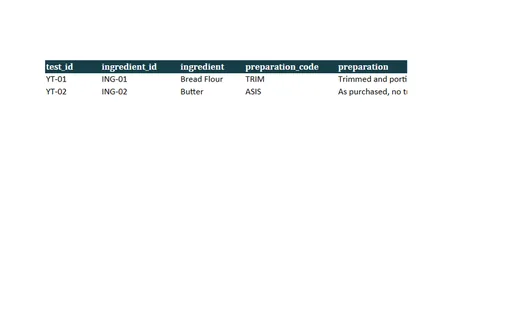
Yield test workbook with live formulas for Copper Oven Bakery. 2 tests over two sheets. Trimmed weight, trim yield, cooking loss and the yield factor are formulas; the last column is an IF that compares the measured trim yield against the yield the recipe applies and writes yes or no.
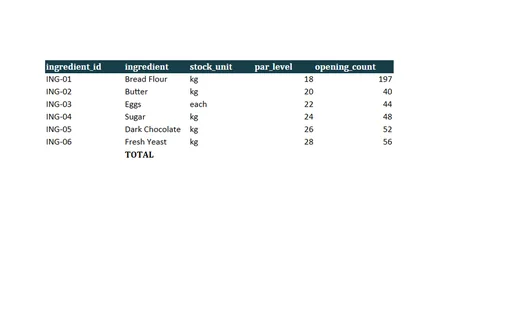
Inventory variance workbook with live formulas for Copper Oven Bakery. 6 ingredients over two sheets. Theoretical closing, the variance quantity, the variance priced at standard cost, the below-par flag and the total are formulas. Theoretical usage is built from the sales table multiplied by the yield-adjusted recipe quantities, so it already carries the yield adjustment.
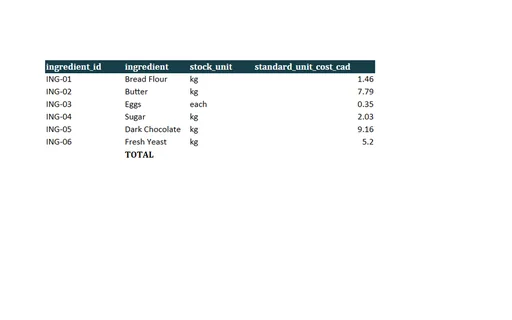
Cost of goods sold workbook with live formulas for Copper Oven Bakery. Four sheets. COGS computes opening plus purchases less closing for 6 ingredients; Reconciliation proves the identity usage and waste at standard, plus the purchase price variance, less the count variance, equals the reported figure; Summary lands on 623.44 CAD against 6651.14 CAD of net menu sales, a food cost of 9.37 percent. The purchases line is the sum of the 24 shared purchase rows dated inside 2026-08-20 to 2026-09-02.
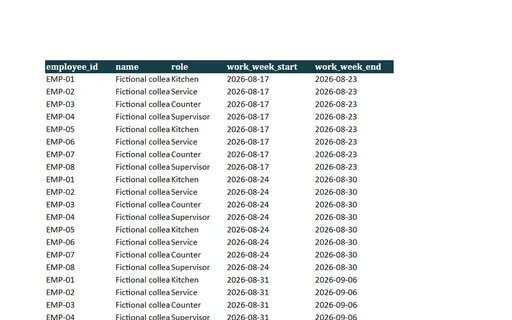
Scheduled hours and overtime workbook for Copper Oven Bakery. Three sheets. WeeklyHours carries 24 employee-weeks over 3 Monday-start work weeks, with weekly overtime above 44 hours, payable overtime as the greater of the daily and weekly figures, and the premium at half the base rate. DailyHours breaks the same segments down into 59 employee-days with a daily overtime formula above 8 hours. The period carries 5.00 payable overtime hours and 51.50 CAD of premium.
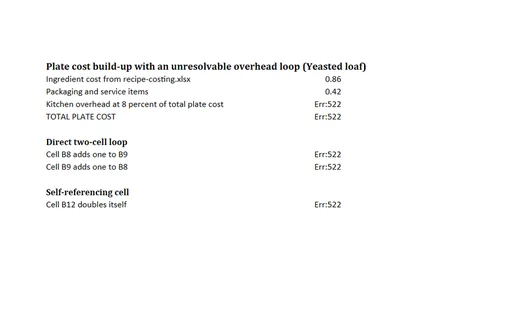
Workbook with intentional circular references for Copper Oven Bakery. Intentionally circular. Two sheets. Three independent cycles: overhead in B4 is eight percent of the total in B5 while B5 adds B4 back in; B8 and B9 each add one to the other; B12 doubles itself. Every other cell is a plain value or a label, and B2 is the real plate cost of MENU-01 (Yeasted loaf) at 0.86 CAD, so the loop is the only thing wrong with the file. Measured in LibreOffice 26.2.4.2, every formula cell on the Circular sheet recalculates to Err:522.
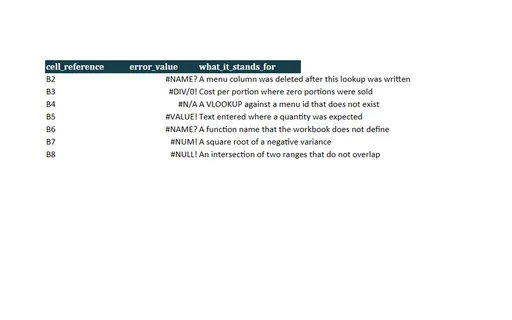
Workbook with Excel error cells for Copper Oven Bakery. Intentionally full of errors. Three sheets. CachedErrors stores 7 literal error cells with the error cell type (#DIV/0!, #N/A, #NAME?, #NULL!, #NUM!, #REF!, #VALUE!), so a values-only reader still sees them. LiveFormulas holds 7 formulas that evaluate to an error on recalculation, including =SUM(#REF!) and =1/0, with no cached value. Its expected_error_excel column names Excel's value; the Notes sheet records the two cases where LibreOffice 26.2.4.2 was measured to disagree, so this file is also a fixture for cross-engine error mapping. The menu ids alongside them are real, so an importer that skips error cells has valid data left.
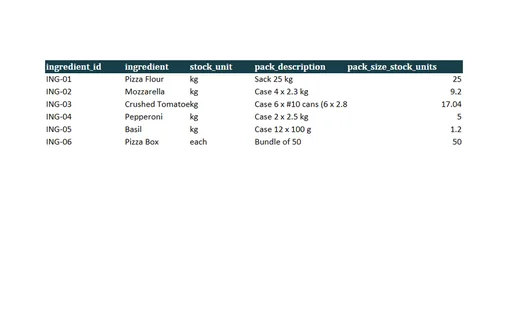
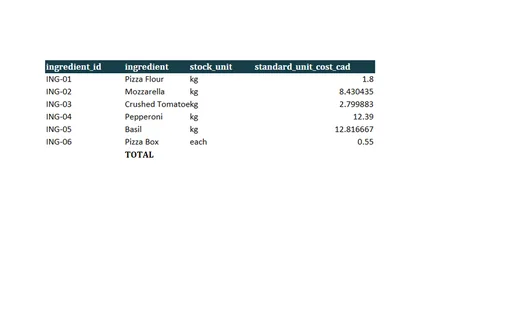
Recipe costing workbook with live formulas for Ember Lane Pizza. Four sheets. Ingredients converts 6 purchase packs to a cost per recipe unit; PlateCosts holds 18 recipe lines; Summary uses SUMIF to roll each dish up and computes margin and food-cost percent; Notes records the provenance. Exactly 91 cells are live formulas with no cached value, so a values-only reader sees them empty and a recalculating reader reproduces plate-costs.csv exactly.
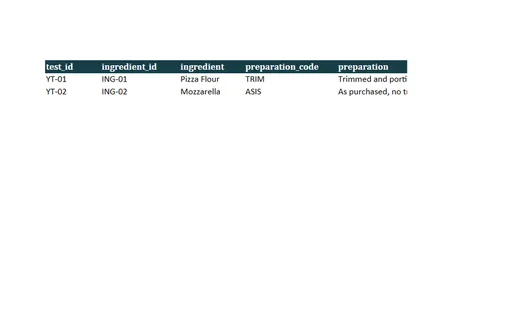
Yield test workbook with live formulas for Ember Lane Pizza. 2 tests over two sheets. Trimmed weight, trim yield, cooking loss and the yield factor are formulas; the last column is an IF that compares the measured trim yield against the yield the recipe applies and writes yes or no.
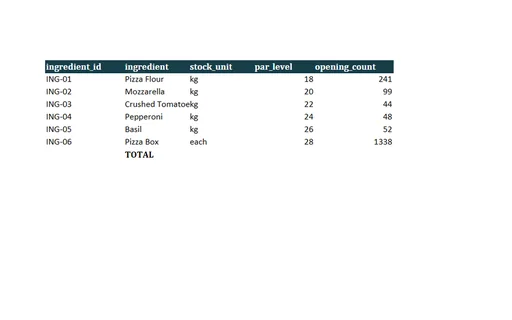
Inventory variance workbook with live formulas for Ember Lane Pizza. 6 ingredients over two sheets. Theoretical closing, the variance quantity, the variance priced at standard cost, the below-par flag and the total are formulas. Theoretical usage is built from the sales table multiplied by the yield-adjusted recipe quantities, so it already carries the yield adjustment.
Cost of goods sold workbook with live formulas for Ember Lane Pizza. Four sheets. COGS computes opening plus purchases less closing for 6 ingredients; Reconciliation proves the identity usage and waste at standard, plus the purchase price variance, less the count variance, equals the reported figure; Summary lands on 3110.43 CAD against 25954.50 CAD of net menu sales, a food cost of 11.98 percent. The purchases line is the sum of the 24 shared purchase rows dated inside 2026-08-20 to 2026-09-02.
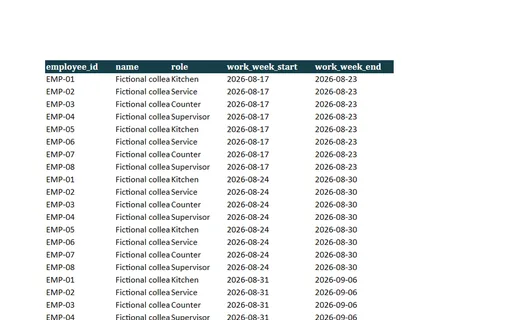
Scheduled hours and overtime workbook for Ember Lane Pizza. Three sheets. WeeklyHours carries 24 employee-weeks over 3 Monday-start work weeks, with weekly overtime above 44 hours, payable overtime as the greater of the daily and weekly figures, and the premium at half the base rate. DailyHours breaks the same segments down into 59 employee-days with a daily overtime formula above 8 hours. The period carries 5.00 payable overtime hours and 51.50 CAD of premium.
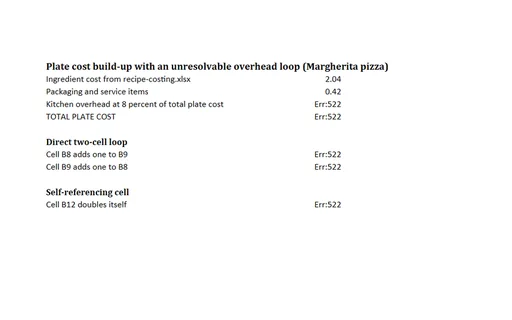
Workbook with intentional circular references for Ember Lane Pizza. Intentionally circular. Two sheets. Three independent cycles: overhead in B4 is eight percent of the total in B5 while B5 adds B4 back in; B8 and B9 each add one to the other; B12 doubles itself. Every other cell is a plain value or a label, and B2 is the real plate cost of MENU-01 (Margherita pizza) at 2.04 CAD, so the loop is the only thing wrong with the file. Measured in LibreOffice 26.2.4.2, every formula cell on the Circular sheet recalculates to Err:522.
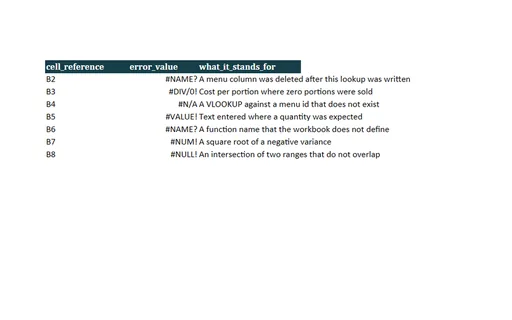
Workbook with Excel error cells for Ember Lane Pizza. Intentionally full of errors. Three sheets. CachedErrors stores 7 literal error cells with the error cell type (#DIV/0!, #N/A, #NAME?, #NULL!, #NUM!, #REF!, #VALUE!), so a values-only reader still sees them. LiveFormulas holds 7 formulas that evaluate to an error on recalculation, including =SUM(#REF!) and =1/0, with no cached value. Its expected_error_excel column names Excel's value; the Notes sheet records the two cases where LibreOffice 26.2.4.2 was measured to disagree, so this file is also a fixture for cross-engine error mapping. The menu ids alongside them are real, so an importer that skips error cells has valid data left.
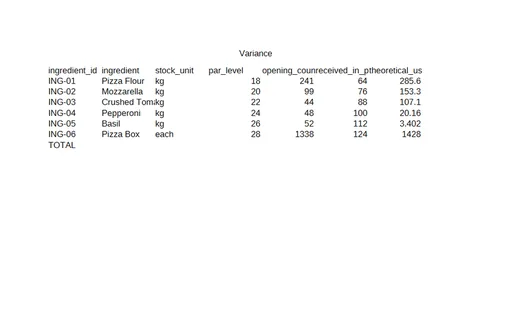
Inventory variance as an OpenDocument spreadsheet for Ember Lane Pizza. Two tables. Theoretical closing, the variance quantity, the variance at standard cost and the total are live ODF formulas over 6 ingredients. The same figures in value form are in inventory-count-sheet.csv.
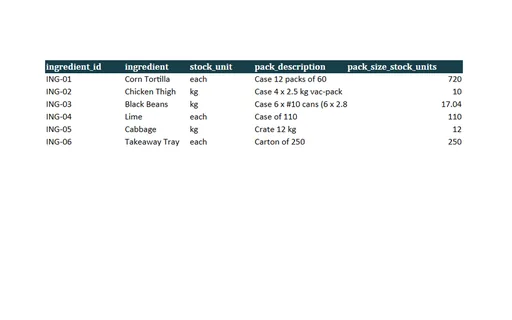
Recipe costing workbook with live formulas for Cedar Street Tacos. Four sheets. Ingredients converts 6 purchase packs to a cost per recipe unit; PlateCosts holds 18 recipe lines; Summary uses SUMIF to roll each dish up and computes margin and food-cost percent; Notes records the provenance. Exactly 91 cells are live formulas with no cached value, so a values-only reader sees them empty and a recalculating reader reproduces plate-costs.csv exactly.
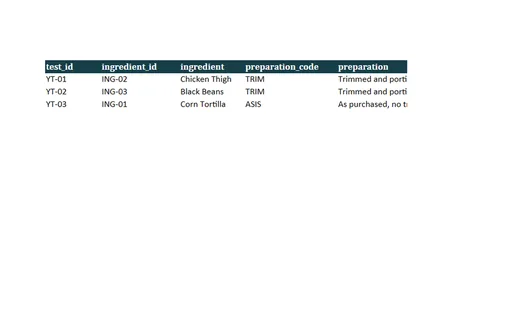
Yield test workbook with live formulas for Cedar Street Tacos. 3 tests over two sheets. Trimmed weight, trim yield, cooking loss and the yield factor are formulas; the last column is an IF that compares the measured trim yield against the yield the recipe applies and writes yes or no.
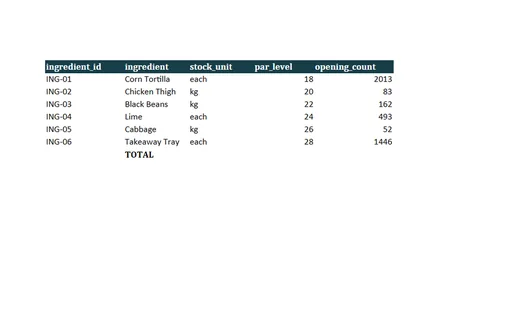
Inventory variance workbook with live formulas for Cedar Street Tacos. 6 ingredients over two sheets. Theoretical closing, the variance quantity, the variance priced at standard cost, the below-par flag and the total are formulas. Theoretical usage is built from the sales table multiplied by the yield-adjusted recipe quantities, so it already carries the yield adjustment.
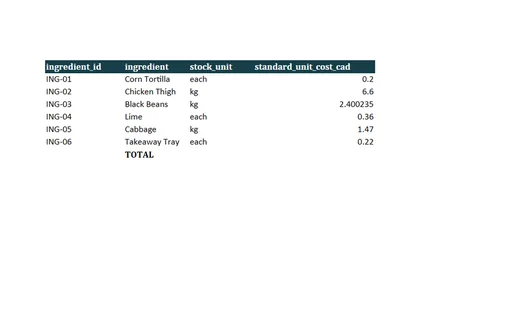
Cost of goods sold workbook with live formulas for Cedar Street Tacos. Four sheets. COGS computes opening plus purchases less closing for 6 ingredients; Reconciliation proves the identity usage and waste at standard, plus the purchase price variance, less the count variance, equals the reported figure; Summary lands on 2559.57 CAD against 19374.60 CAD of net menu sales, a food cost of 13.21 percent. The purchases line is the sum of the 24 shared purchase rows dated inside 2026-08-20 to 2026-09-02.
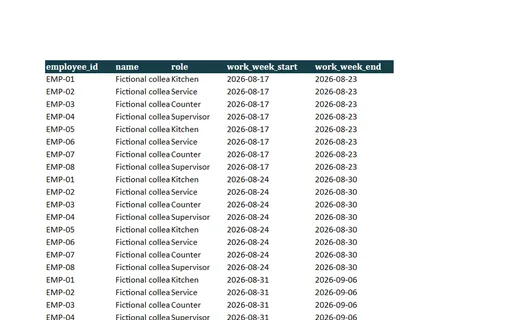
Scheduled hours and overtime workbook for Cedar Street Tacos. Three sheets. WeeklyHours carries 24 employee-weeks over 3 Monday-start work weeks, with weekly overtime above 44 hours, payable overtime as the greater of the daily and weekly figures, and the premium at half the base rate. DailyHours breaks the same segments down into 59 employee-days with a daily overtime formula above 8 hours. The period carries 5.00 payable overtime hours and 51.50 CAD of premium.
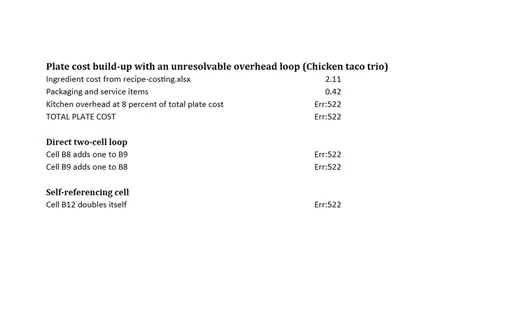
Workbook with intentional circular references for Cedar Street Tacos. Intentionally circular. Two sheets. Three independent cycles: overhead in B4 is eight percent of the total in B5 while B5 adds B4 back in; B8 and B9 each add one to the other; B12 doubles itself. Every other cell is a plain value or a label, and B2 is the real plate cost of MENU-01 (Chicken taco trio) at 2.11 CAD, so the loop is the only thing wrong with the file. Measured in LibreOffice 26.2.4.2, every formula cell on the Circular sheet recalculates to Err:522.
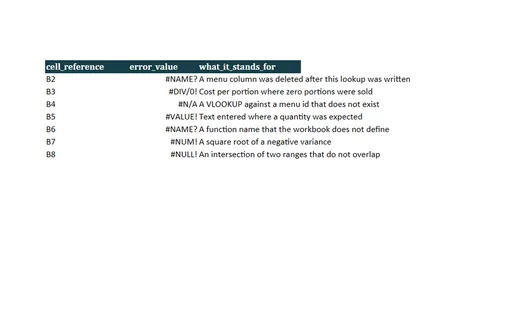
Workbook with Excel error cells for Cedar Street Tacos. Intentionally full of errors. Three sheets. CachedErrors stores 7 literal error cells with the error cell type (#DIV/0!, #N/A, #NAME?, #NULL!, #NUM!, #REF!, #VALUE!), so a values-only reader still sees them. LiveFormulas holds 7 formulas that evaluate to an error on recalculation, including =SUM(#REF!) and =1/0, with no cached value. Its expected_error_excel column names Excel's value; the Notes sheet records the two cases where LibreOffice 26.2.4.2 was measured to disagree, so this file is also a fixture for cross-engine error mapping. The menu ids alongside them are real, so an importer that skips error cells has valid data left.
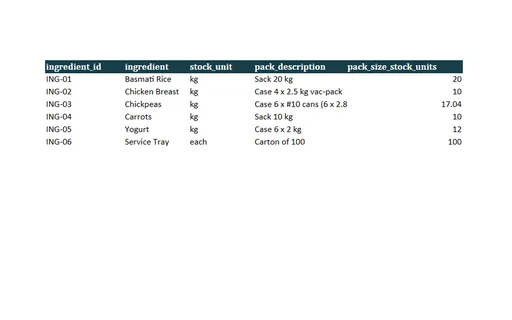
Recipe costing workbook with live formulas for Willow Event Kitchen. Four sheets. Ingredients converts 6 purchase packs to a cost per recipe unit; PlateCosts holds 19 recipe lines; Summary uses SUMIF to roll each dish up and computes margin and food-cost percent; Notes records the provenance. Exactly 94 cells are live formulas with no cached value, so a values-only reader sees them empty and a recalculating reader reproduces plate-costs.csv exactly.
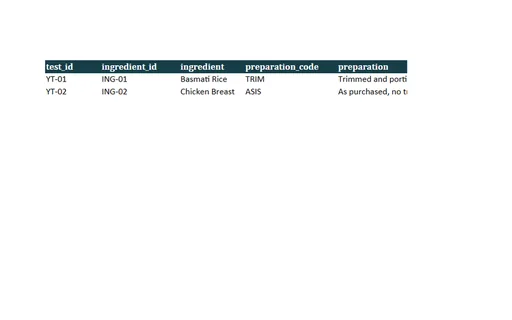
Yield test workbook with live formulas for Willow Event Kitchen. 2 tests over two sheets. Trimmed weight, trim yield, cooking loss and the yield factor are formulas; the last column is an IF that compares the measured trim yield against the yield the recipe applies and writes yes or no.
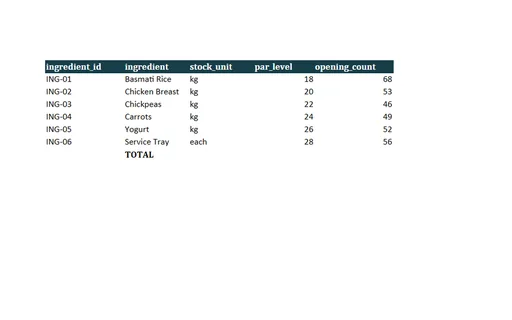
Inventory variance workbook with live formulas for Willow Event Kitchen. 6 ingredients over two sheets. Theoretical closing, the variance quantity, the variance priced at standard cost, the below-par flag and the total are formulas. Theoretical usage is built from the sales table multiplied by the yield-adjusted recipe quantities, so it already carries the yield adjustment.
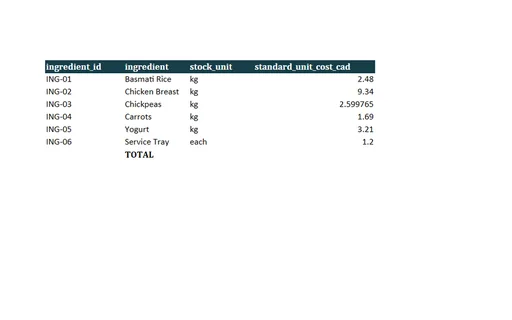
Cost of goods sold workbook with live formulas for Willow Event Kitchen. Four sheets. COGS computes opening plus purchases less closing for 6 ingredients; Reconciliation proves the identity usage and waste at standard, plus the purchase price variance, less the count variance, equals the reported figure; Summary lands on 2106.63 CAD against 28781.90 CAD of net menu sales, a food cost of 7.32 percent. The purchases line is the sum of the 24 shared purchase rows dated inside 2026-08-20 to 2026-09-02.
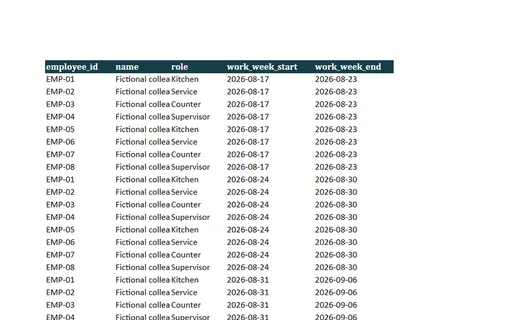
Scheduled hours and overtime workbook for Willow Event Kitchen. Three sheets. WeeklyHours carries 24 employee-weeks over 3 Monday-start work weeks, with weekly overtime above 44 hours, payable overtime as the greater of the daily and weekly figures, and the premium at half the base rate. DailyHours breaks the same segments down into 59 employee-days with a daily overtime formula above 8 hours. The period carries 5.00 payable overtime hours and 51.50 CAD of premium.
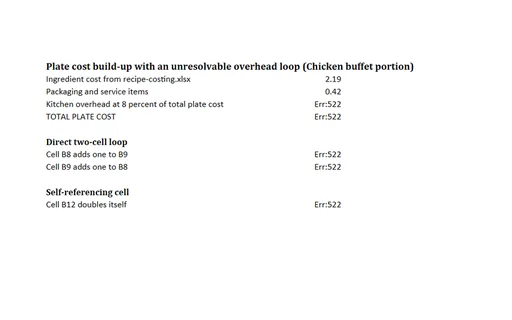
Workbook with intentional circular references for Willow Event Kitchen. Intentionally circular. Two sheets. Three independent cycles: overhead in B4 is eight percent of the total in B5 while B5 adds B4 back in; B8 and B9 each add one to the other; B12 doubles itself. Every other cell is a plain value or a label, and B2 is the real plate cost of MENU-01 (Chicken buffet portion) at 2.19 CAD, so the loop is the only thing wrong with the file. Measured in LibreOffice 26.2.4.2, every formula cell on the Circular sheet recalculates to Err:522.
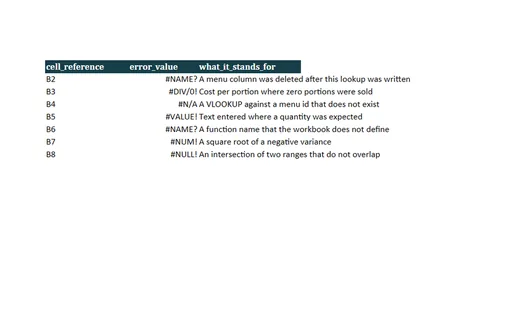
Workbook with Excel error cells for Willow Event Kitchen. Intentionally full of errors. Three sheets. CachedErrors stores 7 literal error cells with the error cell type (#DIV/0!, #N/A, #NAME?, #NULL!, #NUM!, #REF!, #VALUE!), so a values-only reader still sees them. LiveFormulas holds 7 formulas that evaluate to an error on recalculation, including =SUM(#REF!) and =1/0, with no cached value. Its expected_error_excel column names Excel's value; the Notes sheet records the two cases where LibreOffice 26.2.4.2 was measured to disagree, so this file is also a fixture for cross-engine error mapping. The menu ids alongside them are real, so an importer that skips error cells has valid data left.
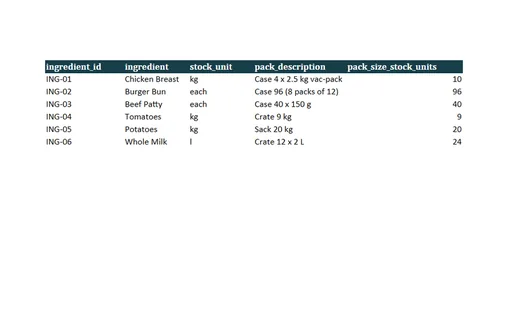
Recipe costing workbook with live formulas for Harbour Kitchen Group. Four sheets. Ingredients converts 6 purchase packs to a cost per recipe unit; PlateCosts holds 10 recipe lines; Summary uses SUMIF to roll each dish up and computes margin and food-cost percent; Notes records the provenance. Exactly 67 cells are live formulas with no cached value, so a values-only reader sees them empty and a recalculating reader reproduces plate-costs.csv exactly.
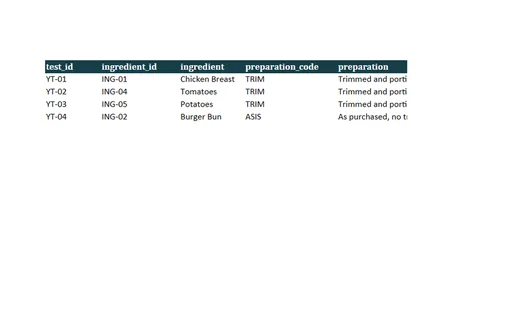
Yield test workbook with live formulas for Harbour Kitchen Group. 4 tests over two sheets. Trimmed weight, trim yield, cooking loss and the yield factor are formulas; the last column is an IF that compares the measured trim yield against the yield the recipe applies and writes yes or no.
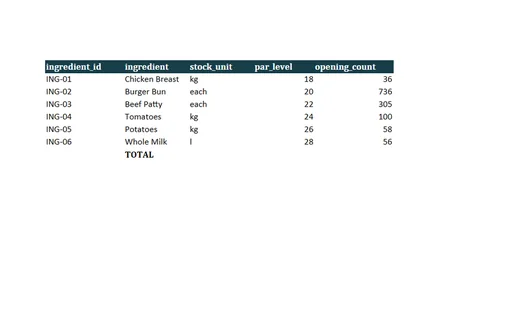
Inventory variance workbook with live formulas for Harbour Kitchen Group. 6 ingredients over two sheets. Theoretical closing, the variance quantity, the variance priced at standard cost, the below-par flag and the total are formulas. Theoretical usage is built from the sales table multiplied by the yield-adjusted recipe quantities, so it already carries the yield adjustment.
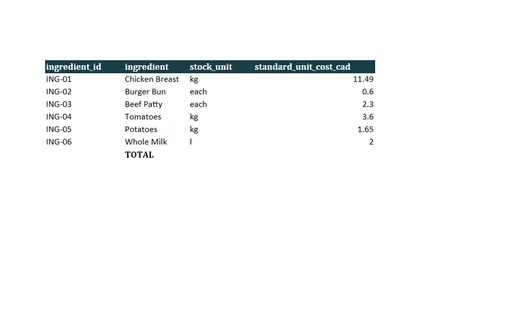
Cost of goods sold workbook with live formulas for Harbour Kitchen Group. Four sheets. COGS computes opening plus purchases less closing for 6 ingredients; Reconciliation proves the identity usage and waste at standard, plus the purchase price variance, less the count variance, equals the reported figure; Summary lands on 3241.08 CAD against 26214.00 CAD of net menu sales, a food cost of 12.36 percent. The purchases line is the sum of the 24 shared purchase rows dated inside 2026-08-20 to 2026-09-02.
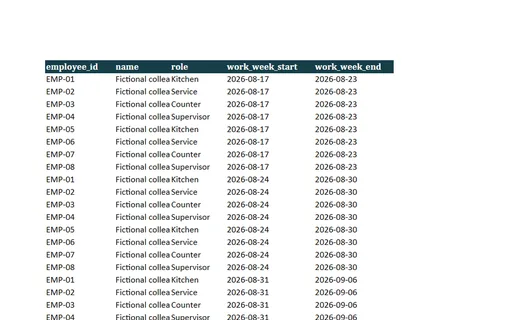
Scheduled hours and overtime workbook for Harbour Kitchen Group. Three sheets. WeeklyHours carries 24 employee-weeks over 3 Monday-start work weeks, with weekly overtime above 44 hours, payable overtime as the greater of the daily and weekly figures, and the premium at half the base rate. DailyHours breaks the same segments down into 59 employee-days with a daily overtime formula above 8 hours. The period carries 5.00 payable overtime hours and 51.50 CAD of premium.
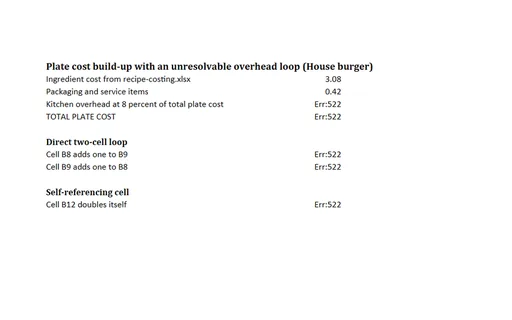
Workbook with intentional circular references for Harbour Kitchen Group. Intentionally circular. Two sheets. Three independent cycles: overhead in B4 is eight percent of the total in B5 while B5 adds B4 back in; B8 and B9 each add one to the other; B12 doubles itself. Every other cell is a plain value or a label, and B2 is the real plate cost of MENU-01 (House burger) at 3.08 CAD, so the loop is the only thing wrong with the file. Measured in LibreOffice 26.2.4.2, every formula cell on the Circular sheet recalculates to Err:522.
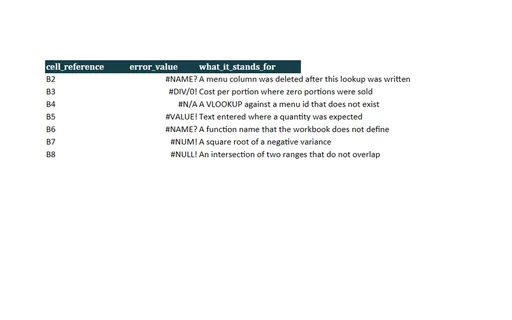
Workbook with Excel error cells for Harbour Kitchen Group. Intentionally full of errors. Three sheets. CachedErrors stores 7 literal error cells with the error cell type (#DIV/0!, #N/A, #NAME?, #NULL!, #NUM!, #REF!, #VALUE!), so a values-only reader still sees them. LiveFormulas holds 7 formulas that evaluate to an error on recalculation, including =SUM(#REF!) and =1/0, with no cached value. Its expected_error_excel column names Excel's value; the Notes sheet records the two cases where LibreOffice 26.2.4.2 was measured to disagree, so this file is also a fixture for cross-engine error mapping. The menu ids alongside them are real, so an importer that skips error cells has valid data left.
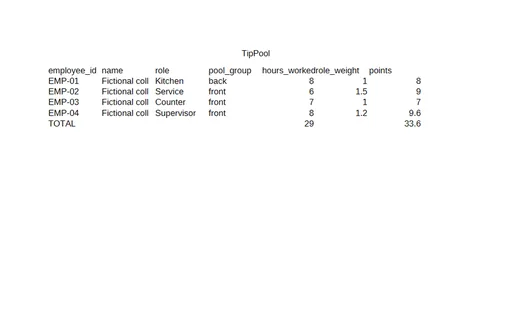
Tip pool as an OpenDocument spreadsheet for Harbour Kitchen Group. Two tables. Points and the allocation total are live ODF formulas; the allocated amounts are the whole-cent largest-remainder shares that sum to the declared pool of 218.61 CAD.