Structured Log: One Oversized Record Between Normal Ones (jsonl)
A single record of about 75 KB (a request body accidentally logged) sitting between two ordinary ones. Most shippers cap a line at 16 or 64 KB and either split it into invalid JSON fragments or drop the records around it; this file makes which one happen visible.
{"ts":"2026-03-17T09:14:32.850Z","level":"info","msg":"normal record before the big one","seq":1}Specifications
- Lines
- 3
- Largest Record Bytes
- 76926
- Typical Record Bytes
- 97
- Above Default64 Ki BLimit
- true
- Cause
- request body echoed into a log field
Testing contract
Expected to pass- Scenario
- Ship all three records through a line-oriented log forwarder.
- Expected result
- The oversized record is truncated or rejected with an explicit marker while records 1 and 3 still arrive intact and parseable.
What is a .jsonl file?
JSONL (JSON Lines) is a text format where each line is a complete, independent JSON value, allowing records to be streamed and appended without parsing the whole file. It is not itself a JSON array and each line must stand alone. It is common in logging, machine learning datasets, and data pipelines.
How to use this file
Use an example JSONL to test line-by-line streaming parsers, append-and-resume ingestion, and batch pipelines that process one record per line.
How to use this file for testing
“Structured Log: One Oversized Record Between Normal Ones (jsonl)” is a deterministic Testaroo fixture for Observability, Log parsing, Performance testing. Structured and plain-text telemetry with known timestamps, levels, request identifiers, and error states for testing log ingestion, correlation, dashboards, and alert pipelines.
Documented properties for this file: JSONL · 77,122 bytes. Compare results against paired or grouped companions on this page when present (clean↔damaged, searchable↔scanned, or format twins) so scores stay reproducible across runs.
Download the file once, keep the path stable in CI or local scripts, and treat the spec table as the contract: dimensions, seeds, field lists, and roles are intentional. Corrupt or invalid samples are labelled as such, expect parsers to fail loudly rather than silently accept them.
Telemetry fixtures use fixed trace IDs, span IDs, and timestamps so ingestion is reproducible run to run. Point your collector, parser, or query layer at the file and assert the documented span tree, metric families, or severity mix; service and host names are invented.
Code examples
import json

with open("app-oversized-record.jsonl") as f:
    rows = [json.loads(line) for line in f]
print(len(rows), rows[0])
Generated by generation/observability.py. Free for any use, no attribution required, license.
Related files
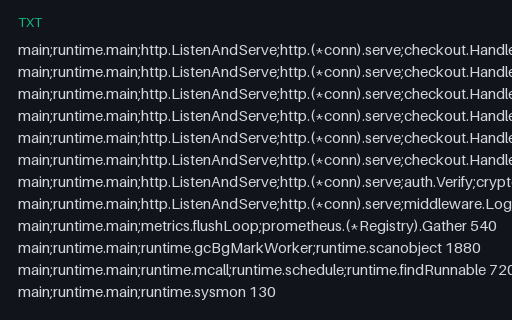
- txtCPU Profile: Folded Stacks, Baseline (txt)A CPU profile in the folded-stack format every flamegraph tool reads: one line per unique stack, frames separated by semicolons, then a space and a sample count. Twelve stacks up to seven frames deep, with the runtime's GC and scheduler work included as real profiles have.
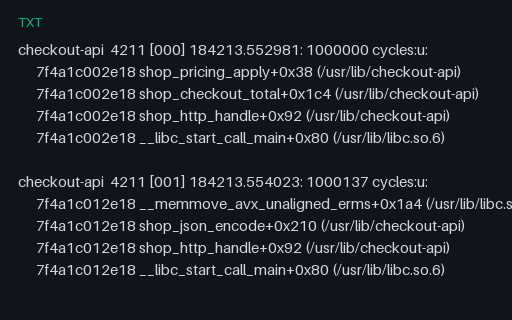
- txtLinux perf script: Sample Records with Call Chains (txt)Raw perf script output: a header line per sample followed by tab-indented call-chain frames with addresses, symbols, offsets and DSO paths, samples separated by blank lines. The input side of stackcollapse, including unresolved frames a symbolizer could not name.
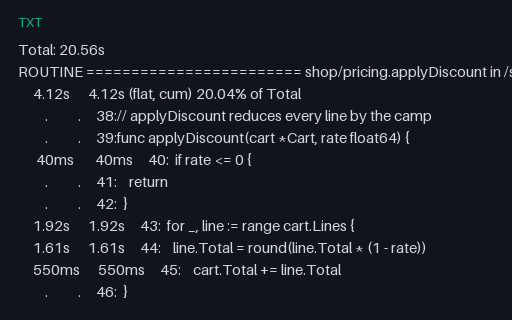
- txtpprof: Annotated Source Listing (txt)Line-level profile output: two routines with per-source-line flat and cumulative cost, a dot for lines that cost nothing, and units that switch between seconds and milliseconds within one column. Source lines keep their real tabs, which most column parsers do not survive.
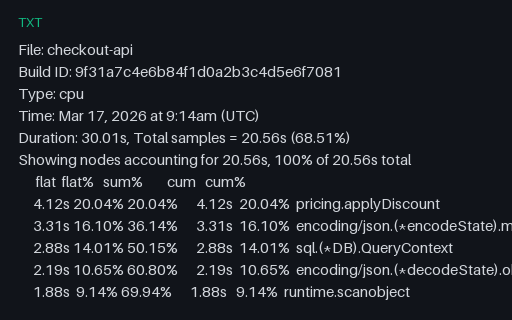
- txtpprof: Top Report Text Output (txt)The text report pprof prints for the same profile as the folded fixtures: a metadata header, then flat and cumulative columns where frames that are never a leaf carry zero flat time and near-total cumulative time. Column-aligned output with a bare 0 rather than 0s, which is where naive column parsing fails.
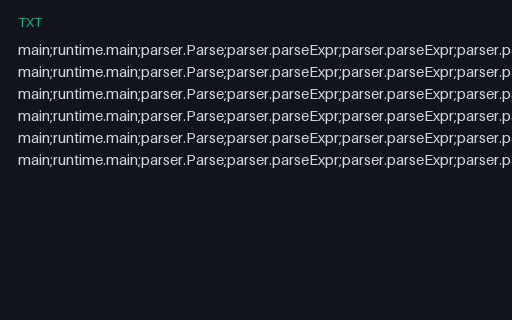
- txtProfile: 200-Frame Recursive Stack (txt)A recursive-descent parser profiled mid-recursion: stacks up to 204 frames deep where one frame repeats 200 times, on lines over 3,000 characters. Flamegraph renderers with a fixed depth limit truncate this silently, and line-length limits split it into nonsense.
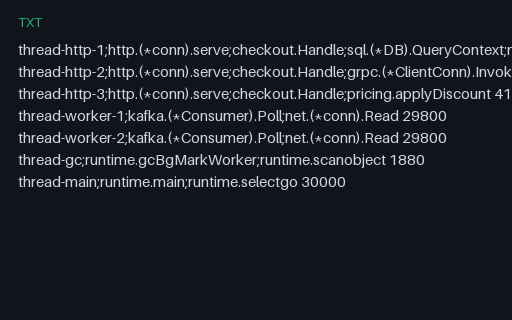
- txtWall-Clock Profile: Per-Thread Folded Stacks (txt)A 30-second wall-clock profile with the thread name as the root frame, so time blocked in reads is visible instead of invisible. Off-CPU time dominates: the shape that tells you a service is waiting, not computing, which a CPU profile alone cannot show.