SAMPLE RSA Private Key: PKCS#1, Unencrypted
The identical key material wrapped in the legacy PKCS#1 container (BEGIN RSA PRIVATE KEY), which omits the algorithm OID that PKCS#8 carries. Diff it against its PKCS#8 twin to see exactly what a container migration changes.
-----BEGIN RSA PRIVATE KEY-----
MIIEogIBAAKCAQEAvFQ+FKvpOhgmcptUhCZk9Qi/Lc9ginBBdHVVfX7GBD1Lre3h
2zBK0ZuqzKhrXjag+hMcyRVolyoPnfpCGmn+Jr2QtPAE0UjuG07wWf1I6dhg7dPH
jkeWAEzDqT2tb244jnYKVPVzTj7X6L3BUveZfFiKqzGZp2peQSJ56Coe13XSRdtD
UtoG1VYu50Ps9QJR6oKv9b0ujuKc7dhL/ea6vWrcgVLggKj02auQehLqZ8HOasmx
Ppr/LW0kcEwCShbHPc2qkgZ7YqNocxbSB9AdO1Fn3GRVAcY1huI3nLPQ4xL7bzmi
inyEac0nPRfcyzIrtZI/3LHaNrW7lSbMWX+9twIDAQABAoIBAA8/2FxezzPKYNKc
NpZncCVR3/5wRvuZZgjCt3lsmnwdZSi1lQ7lNNRkK8sGmCsOIVrJJruMOuaCnAvJ
XTDmWZNUJjOAe+NhFGasWFSbvcZcTvzy+RBRm5kf83fwwT+/R7UWucocqzQwF9Yw
sfFrOx0RI6lZCtK+Oi5BVxMFgMR8EktahBx2VYPcnSIS1EBBnFRZxN8BHfGp+bFo
WZ6EdgTkyyuZfLgicau1y7GwwgTGWatB1HETB+3NVP0RKCrE7+oNMFK7KEKskDVs
qVGPczuWrtl5Yq4pFmt5KCidTv+si1iiN19cJbJTdlaTyCXnDU12ifS0Gv6ARdmk
Ahm5i4ECgYEA3ST1lXzxf6FCplBzJe/0w20zIUleIl9PmVSKMKHalchYTbt4QGTW
TMLv8H5nm7FlbjBLWo5+Rgs//KjMMcLycKaFlCarwFKaRRsoPmLX8OGxaH37iDXW
+Mji5XfxeqeG+8TKcIlGujqEoFL+JGtguVLOeS+k9HwsKb3xSoKJoZ0CgYEA2gM0
sRnXtYmmZWd6BinRxgh3P8cY9KN8VuzTG0kZ0ajone8NbJK6xUBPdvh+4BHO8YSN
RpiYjuX5kEAgn5Us0/AvZvQxCN4ljssXCAYO1yubYJ2P1fPCw1caawPR69yQ3r2X
VOttomEDKAGKN0OOI/PyPosundHr5oYz6WDR1mMCgYBQUBDkhmjKWk1zSzpWZ8vz
gWAVUajfQNAOtnYtbUqOJSF0sYXdlQGDBTTQmYeVMprMprtnGuLfG0zUvJTT6aHU
qZVPla/Ae/9M46z84zbbY4vjkAVelXcKCSLmBWZsjhTmsLR4pFJMZd4uv5VOsrSA
+YLE3jnBFKuRSUstLTVAvQKBgGjyOh82zXv6MzuFQFxPLUgjMyRkd0LsoCJIBqeP
3PnsUW4VcWTejUH+30HqBUlfyTrCEC/3rRi85BHojMvFR7sOWAM7cY9PQM0oPoIC
SIqT10v/DQp1OUBHYdQ6Fodvud0/buXWHwSXpqlPdHV986Ki/+3TmjEmqGRkHgEu
NlT5AoGAbMBv0EDYR0Zc75ZdVN0FadEGb0C8xu/GCSigOAG7+c29YKUdhMQ3mC1f
8eWLpApznbQsJVV3hR6mPIjDHy/GTJjDQbbocnB3rZhZN/QKz45Wr8mCsNuBH6y8
cqPTEZjg/h0a+v2fwEmgbjtdxbuQ7jp6MaR43XTVHkO0bAdy7fw=
-----END RSA PRIVATE KEY-----
Specifications
- Algorithm
- RSA
- Bits
- 2048
- Container
- PKCS#1 (traditional OpenSSL)
- Armour
- BEGIN RSA PRIVATE KEY
- Encrypted
- false
- Note
- same key material as the PKCS#8 twin, different container
- Sample Only
- true
- Seed
- 70117
Testing contract
Expected to pass- Scenario
- Load both this key and its PKCS#8 twin and compare their RSA private numbers.
- Expected result
- Both containers yield identical modulus, exponents, and primes despite different PEM armour.
What is a .key file?
A .key file holds a private key, usually PEM-encoded in PKCS#8 (BEGIN PRIVATE KEY) or a key-type-specific format. It is the secret half of a TLS or SSH identity and must normally be protected. The examples here are published, sample-only keys that must never be used in production.
How to use this file
Use an example .key to test PEM key parsers, PKCS#8 decoders, and key-format converters (for example PEM to DER or OpenSSH). These are deliberately published sample keys, for parser testing only, never for real use.
How to use this file for testing
“SAMPLE RSA Private Key: PKCS#1, Unencrypted” is a deterministic Testaroo fixture for Certificate & key testing, Conversion testing. Self-signed X.509 certificates (PEM, CRT, DER), a CSR, RSA and Ed25519 keys, an SSH public key, a PKCS#12 bundle, and an htpasswd file, all published sample-only material, for testing certificate parsers, TLS tooling, keystore importers, and PEM/DER decoders.
Documented properties for this file: seed 70117 · RSA. Compare results against paired or grouped companions on this page when present (clean↔damaged, searchable↔scanned, or format twins) so scores stay reproducible across runs.
Download the file once, keep the path stable in CI or local scripts, and treat the spec table as the contract: dimensions, seeds, field lists, and roles are intentional. Corrupt or invalid samples are labelled as such, expect parsers to fail loudly rather than silently accept them.
This is published, SAMPLE-only security material, never a real secret. Point certificate, key, or token parsers at it, test PEM/DER decoding and PKCS handling, and confirm your tooling reads the documented fields; any sample password is printed on this page.
This is a published, sample-only certificate/key. Parse it, verify the chain or signature, and test PEM↔DER conversion, never deploy it anywhere real.
Generated by generation/security_p7.py. Free for any use, no attribution required, license.
Related files
- derSAMPLE Certificate Revocation List (DER)Binary DER twin of the SAMPLE CRL: the exact encoding a CRL distribution point serves over HTTP. Use it to test binary CRL fetching and caching paths that never see PEM armour.
- derSAMPLE Intermediate CA Certificate (DER)Binary DER encoding of the SAMPLE intermediate CA certificate: the same bytes the PEM twin Base64-wraps. Feed it to ASN.1 decoders, Java keystores, and DER-to-PEM converters.
- derSAMPLE Leaf Certificate (DER)Binary DER encoding of the SAMPLE leaf certificate: the same bytes the PEM twin Base64-wraps. Feed it to ASN.1 decoders, Java keystores, and DER-to-PEM converters.
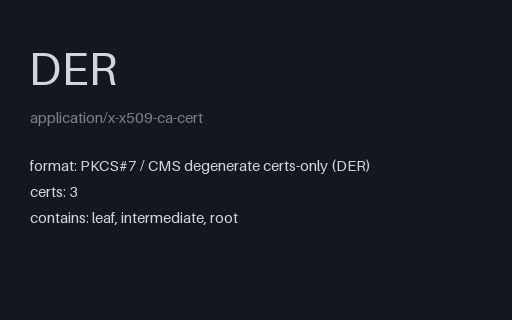
- derSAMPLE PKCS#7 Certificate Bundle (DER)Binary DER form of the same three-certificate PKCS#7 bundle, the encoding a .p7b download actually uses. Use it to test importers that never see the PEM armour.
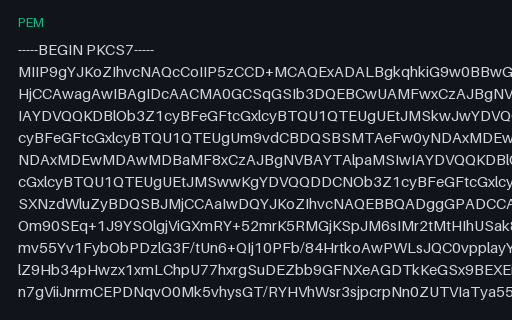
- pemSAMPLE PKCS#7 Certificate Bundle (PEM)A degenerate (certificates-only) PKCS#7 structure holding all three SAMPLE certificates under BEGIN PKCS7 armour: the payload Windows and Java tools distribute as a .p7b. It carries no private key and no signature over any content.
- derSAMPLE Root CA Certificate (DER)Binary DER encoding of the SAMPLE root CA certificate: the same bytes the PEM twin Base64-wraps. Feed it to ASN.1 decoders, Java keystores, and DER-to-PEM converters.