Find files, editable templates and browser test targets by what you need to make or test. The directory below is cut by format; the two collections under it cut the same library by subject and by workflow.
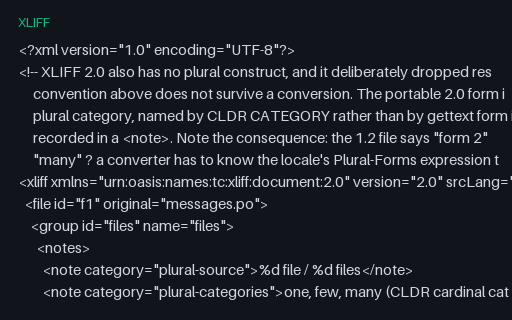
The XLIFF 2.0 half of a version twin covering how each version expresses a plural group. XLIFF 1.2 uses a <group restype="x-gettext-plurals"> whose trans-units are ordered by gettext form index; XLIFF 2.0 dropped restype, so the same content becomes one <unit> per CLDR category, named by category rather than by index.
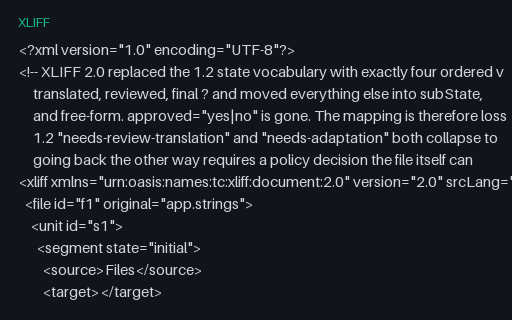
The XLIFF 2.0 half of a version twin covering how each version records translation progress. XLIFF 1.2 has approved="yes|no" plus a ten-value target state; XLIFF 2.0 removed approved and cut the vocabulary to four ordered values (initial, translated, reviewed, final) with everything else pushed into a namespaced subState.
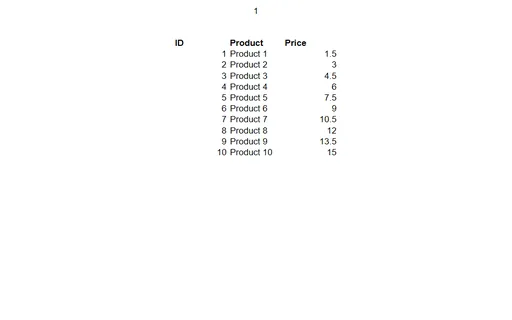
A legacy Excel 97–2003 (.xls / BIFF8) workbook holding the same tabular data as the plain XLSX and ODS, for testing legacy-format readers and XLS↔XLSX conversion.
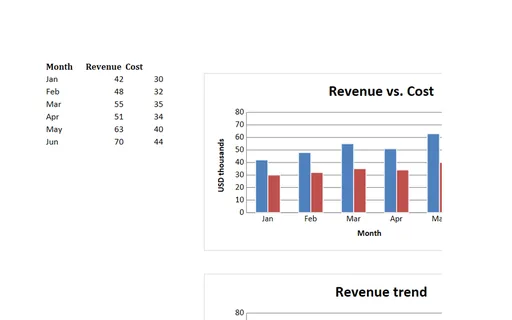
A workbook with a data table plus a native bar chart and a line chart bound to the cells, for testing whether spreadsheet parsers and XLSX-to-PDF converters preserve and render embedded charts.
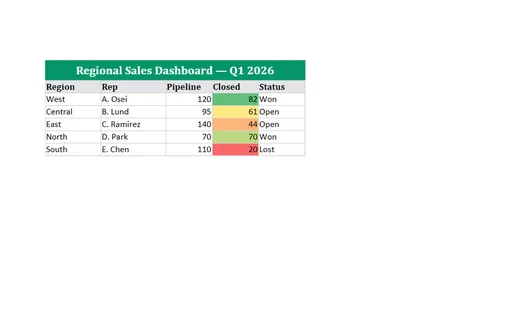
A dashboard sheet exercising the features importers miss: a merged title cell, a three-colour conditional-formatting scale, a data-validation dropdown, cell borders, and frozen panes.
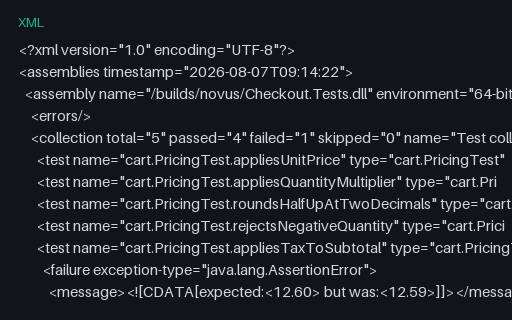
The xUnit.net v2 shape: an <assemblies> root holding one assembly, whose tests are grouped into collections rather than classes. Result values are Pass, Fail and Skip with capital initials, which trips converters doing a case-sensitive comparison against the lowercase values every other format uses. Reports the same canonical run as the JUnit dialect files: 12 tests, 9 passed, 1 assertion failure, 1 error and 1 skip.
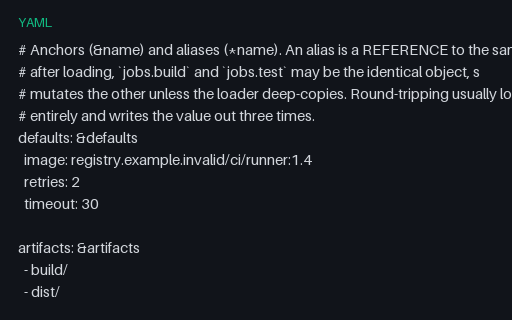
Anchors and aliases across mapping, sequence and scalar nodes, including an anchor nested inside another anchored node. The point most tooling misses: an alias is a reference to the same node, so a shallow-loading parser can share mutable state between jobs.
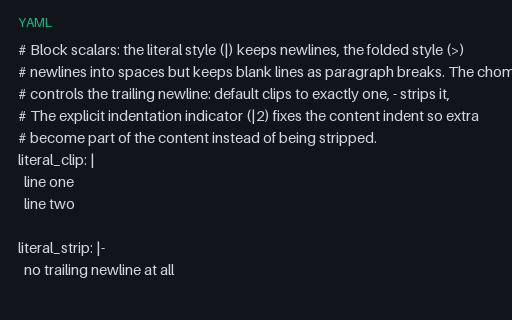
Every block-scalar variation in one file: literal and folded styles, all three chomping indicators, an explicit indentation indicator, a folded block with a paragraph break, and an embedded shell-shaped script whose own indentation must survive.
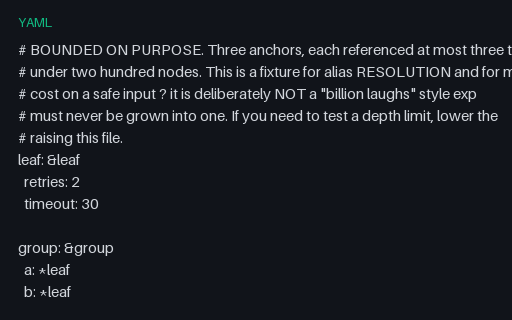
Nested anchor reuse kept deliberately small: two anchors, six references, thirty-one expanded nodes. It is here to test alias resolution and expansion accounting on a safe input, and is explicitly not a billion-laughs expansion bomb.
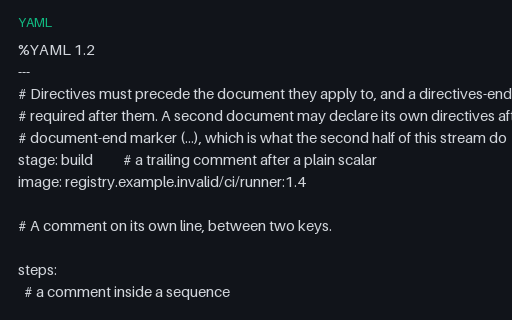
A two-document stream where each document declares its own %YAML directive and the second adds a %TAG handle used by a local tag. Comments appear in every position they are legal, and every one of them is lost by a non-round-tripping loader.
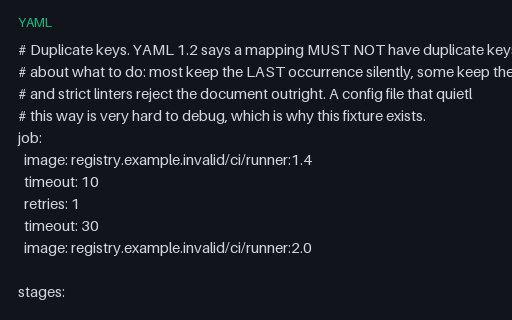
Duplicate keys at three nesting levels, including a duplicated top-level sequence. The spec forbids them; most loaders keep the last silently, a few keep the first, and strict linters reject the document. The file publishes the last-wins answer.
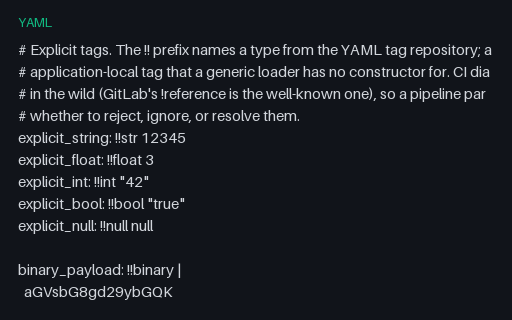
Explicit tags across the standard set (!!str, !!float, !!int, !!bool, !!null, !!binary, !!timestamp, !!omap, !!set) alongside two application-local ! tags. CI dialects use local tags in the wild, so a pipeline parser has to decide whether to reject, ignore, or resolve them.
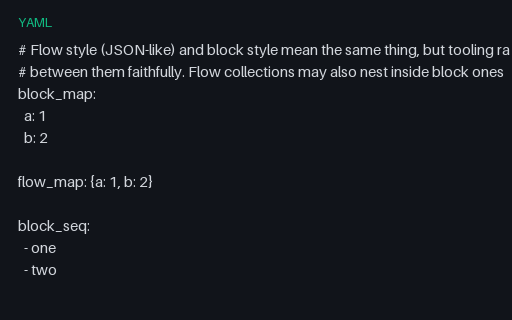
Flow (JSON-like) and block collections expressing the same structures, nested inside one another in both directions, plus a flow mapping wrapped across lines and a line of strict JSON, which is valid YAML, and a useful check on a parser's JSON-subset claim.
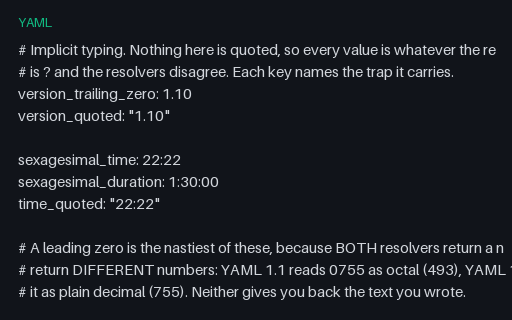
Twenty-two unquoted values whose type depends entirely on the resolver. The worst is the leading zero: 0755 is 493 under YAML 1.1 and 755 under YAML 1.2, so both resolvers return a number and they return different ones. Also covers base-60 times, a version that loses its trailing zero, an integer past IEEE-754 precision, dates, and .inf / .nan.
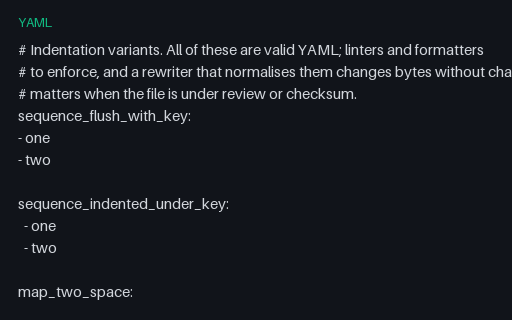
The indentation styles that all parse identically and that formatters fight over: sequences flush with their key versus indented under it, two-space against four-space maps, and deliberately irregular but legal nesting. For testing formatters and idempotency.
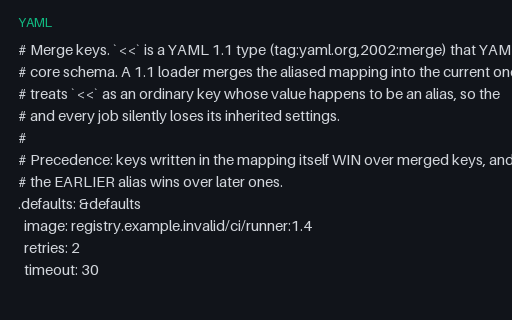
Merge keys with their full precedence rules: local keys beat merged ones, and in a merge sequence the earlier alias wins. The file publishes the expected merged values, and a strict YAML 1.2 loader produces none of them because 1.2 dropped << from the core schema.
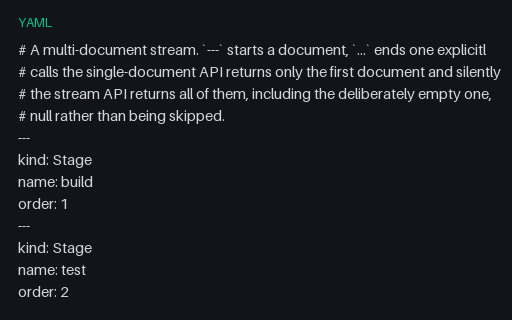
A five-document stream with explicit end markers, a comment-only document that loads as null, and a bare sequence as a whole document. The single-document API returns only the first, which is how multi-object manifests silently lose objects.
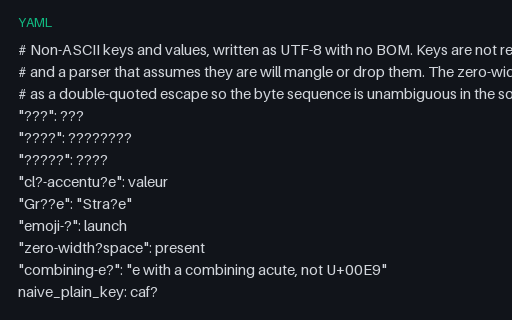
Non-ASCII keys and values across Latin, Cyrillic, Arabic, CJK and emoji, plus a key containing a zero-width space and a value distinguishing a combining acute from the precomposed character. Written as UTF-8 with no BOM.
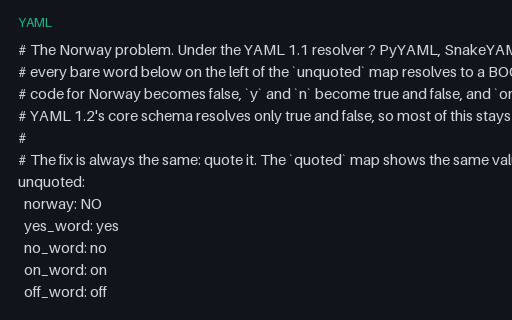
The Norway problem in full: eleven bare words that a YAML 1.1 resolver turns into booleans, a matching quoted control group that survives, and a country-code list where position two silently becomes false. The definitive fixture for resolver-version behaviour.
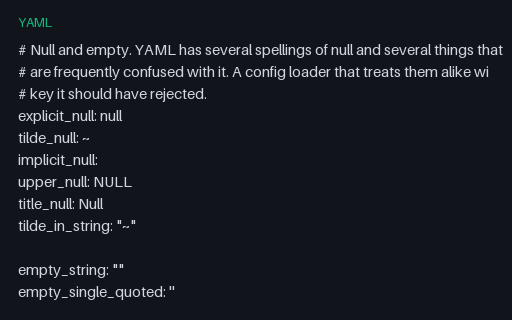
Five spellings of null against the things routinely confused with it: empty strings, empty collections, and a key written with no value at all. Includes a sequence containing a hole, an empty string and two nulls in a row.
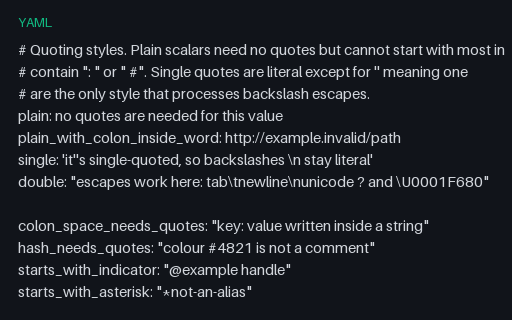
All three scalar quoting styles side by side: plain scalars and what they cannot contain, single quotes where backslashes stay literal and '' means one quote, and double quotes as the only style that processes \t, \n and \uXXXX escapes.
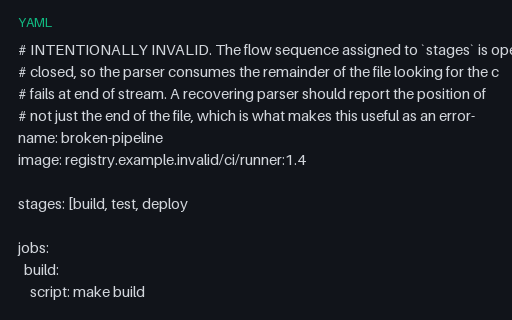
An intentionally invalid YAML file whose flow sequence is opened and never closed, so the parser consumes the rest of the document and fails at end of stream. A good error message names the opening bracket, not the last line, which is what this fixture measures.
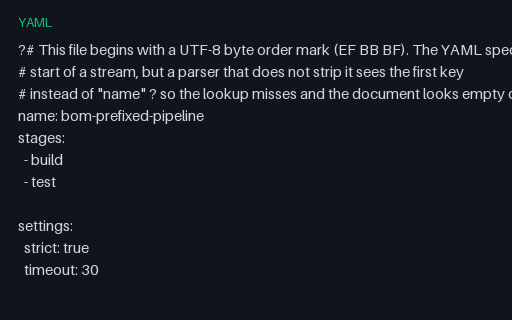
A YAML file beginning with a UTF-8 byte order mark, which the spec permits at the start of a stream. A parser that does not strip it reads the first key as \ufeffname, so the lookup misses and the document appears to be missing its name field.